VI VERI VENIVERSUM VIVUS VICI


Affichage des articles dont le libellé est freemasonry. Afficher tous les articles

dimanche 5 décembre 2010

FREEMASONRY IN THE EARLY 1600 AND 1700


There is such an abundance of evidence in proof of the continuity of Freemasonry during the period selected, that it is only necessary to study the special records of the old Lodges, happily still preserved, the Rolls of the "Old Charges", and especially the extant minutes of the Masons' Company of London, to be assured that the Freemasons of the present day are the lineal descendants of the operative builders, who in the 17th century, and earlier, admitted speculative or non-professional members.

The 17th century operative Masons were most favourable to the speculative element in their midst, and encouraged their admission to such an extent, that sometimes the Lodges consisted almost exclusively of brethren in no way connected with building. Several examples of this remarkable feature may be cited, such as the Lodge at Warrington in which Ashmole was initiated in 1646. An extraordinary instance of the preponderance of gentlemen in an operative Lodge, is met with at Aberdeen in 1670, for of forty-nine members registered in the "Mark Book" with their marks attached, not a dozen were operatives; the Master was a Tutor at Airth and Collector of the King's Customs, while several of his companions were noblemen or of the educated class.

The oldest Masonic minutes known are those of the senior Lodge in the world, viz., No 1 Edinburgh. They begin in the year 1599, the Lodge having continued at work, as the records testify, from then to now, thus overlapping the transition period and the final predominance of the speculative branch, by the formation of modern Grand Lodges. The monopoly of the operatives gradually disappeared, and Masonry itself became as free practically as Freemasonry is at the present time. A silent revolution was going on in the Craft throughout the 17th century, and what with the changes in Society generally, and the failure of the Companies to enforce regulation, which had become obsolete and unsuitable to the times, Masonry, as with other trades, had to alter its laws and customs accordingly.

The Lodge of Edinburgh and others in Scotland were legally governed during the period in question by the statutes of 1598-9, promulgated by William Schaw "Maister of wark, Wairden of ye Masons," of Royal appointment. There were three "Head Lodges" in the kingdom, as recognised in the code of 1599, which were described as Edinburgh "the first and principall ludge," Kinwinning "the second ludge", and Stirling "the third ludge". This trio still exists, and the Lodges are now on the roll of the Grand Lodge of Scotland as Nos.1, 0 and 30 respectively.
Naturally several of the clauses in the above-named statutes relate to matters common to all the crafts, but others are of a distinctive character and most suggestive. The Lodge of Edinburgh was a kind of Metropolitan Grand Lodge, having control of the local, but before the 17th century ended, its rights were often violated or ignored, and Lodges were formed in its vicinity or jurisdiction, that it was powerless to prevent, although issuing fulminations that were still-born. The "Canongate Kilwinning" Lodge No. 2, was formed in 1677, as an offshoot from "Mother Lodge Kilwinning", and in 1688, a secession from the Lodge of Edinburgh resulted in the establishment of the "Canongate and Leith, Leith and Canongate" Lodge, now No. 5, and notwithstanding all the means used by the Mother Lodge, only one of the seceders was induced to return to the fold. Then, again, early in the 18th century, the journeymen were not satisfied with the masters' regulation and control; they seceded and started a Lodge on their own account, and what is more gained a victory over their powerful opponents, though Master Masons, by persisting in giving the "Mason Word" to neophytes, the prerogative previously of their superiors. Two of their number were imprisoned for contumacy, but an appeal to the Court ended in their being allowed, as per the "Decreet Arbitral" of 1715, to assemble as a separate organisation, and esoterically - i.e., to communicate the "word" - as well as generally, to conduct their own Lodge, then and since known as the "Journeymen", now No. 8 on the roll. The Masters were fined a hundred pounds for their high-handed conduct, which fine has not yet been paid.

The attendance of Apprentices at the Lodge during the making of Fellow-crafts is confirmed by the minutes of 1601, 1606 and 1637, while the "Schaw Ordinances" provided for the presence of six Masters and two Apprentices, in like manner, on the making of Masters, a privilege subsequently assumed by the Incorporation. Operative Essays were obligatory in relation to both classes, Essay Masters being appointed, and also "intenders for instruction;" represented in Modern Lodges by the questions preparatory to promotion, and the proposers and seconders of candidates respectively.

The first minute of the Lodge of Edinburgh containing an entry concerning speculative membership is dated 8th June, 1600, and is the oldest of the kind known in Great Britain and Ireland. The Brother was John Boswell, Esq., the laird of Auchinleck, who attended as a member, and whose name and mark attested the minutes, along with twelve operatives who likewise agreed to the business transacted, and acquiesced in the same manner. When he joined we cannot tell.

The head of the Lodge was generally styled "Deacon," while the "Warden" was the medium of communication with the "Warden General", who was a kind of Grand Master, the prototype of our modern Grand Lodge Rulers. William Schaw was styled "Chief Maister of Maissonis" in the 16th century and later.

In the 17th century, it was quite a common occurrence for noblemen and gentlemen to occupy the Chairs of Lodges, even if only Apprentices, as with the Earl of Cassillis, who in 1672 was Deacon of "Mother Lodge Kilwinning", being followed by Sir Alexander Cunninghame and the Earl of Eglintoune, also an Apprentice. Harry Elphington, Tutor of Airth and Collector of the King';s Customs, was Master of the Lodge of Aberdeen - now No. 1 tris - in 1670, the members of which were mostly speculatives, though an operative Lodge. Lord Strathallan was the Master or President of the Lodge of Dundee, - known as the "Lady Luge of Dundee" in 1536. Other instances could also be cited.

The old Lodge of Kilwinning ewxercised jurisdiction even as far as Glasgow, according to the Code of 1599, and was to all intents and purposes a Provincial Grand Lodge, thus foreshadowing the present arrangement, whereby its R.W.M. for the time being occupies the honourable position of Provincial Grand Master of Ayrshire.
Then, again, the protectorate of the Craft in Scotland was hereditary in the St. Clair family, the Lairds of Roslin, being secured by charters of 1600 and 1628 circa, which led to the claim being made that they were Grand Masters, which the documents in no way countenance. The Lairds of Roslin were simply Patrons and Protectors of the "Maissones and Hammermen" with other crafts, but that obsolete and purely honorary distinction was sufficient to secure the election in 1736, on sentimental grounds, of one of the family, as the first Grand Master of Scotland.
Other local magnates were appointed to the oversight of the Craftsmen in cerrtain districts, such as Patrick Coipland of Udaucht as Warden of the "airt and craft of Maisonrie" over three sheriffdomes in Scotland in 1590. These were clearly the precursors of the general and local Craft bodies which sprang up during the 18th century in Great Britain and Ireland. But time will not permit any reference to such just now. This much, however, may be noted, that excepting the arrangement of separate Masonic degrees and ceremonies peculiar to the post Grand Lodge period, it is not easy to discover many important features of the Craft in the eighteenth century, which are not represented in the regulations and customs of the Scottish Craft in the present century.

Until the precise character of the Records of the Masons’ Company of London was made known - quite recently - it was believed that the admission of Quarter Master General Moray, of the Scottish Army, at Newcastle on Tyne in 1641, by members of the Lodge of Edinburgh, was the earliest instance of the initiation of a “speculative” in England. Now, however, that the invaluable transactions of the before-mentioned Company are accessible, it is found that there was a speculative Lodge at work, under the wing of that body, the existing accounts of which go as far back as 1620. The meetings were termed “the Acception,” and the candidates were received as “Accepted Masons;” the Company being then known as Free masons, though the prefix was dropped during the latter half of the 17th century. The dual character of the Company is established by reference to the accounts, for the actual minutes are missing prior to 1670. Beside those who obtained the “freedom of the Company” by patrimony or servitude, there were others who were admitted by redemption, and it is quite possible that being “accepted” by the Lodge, though not connected with the building trade, strengthened their application for the “freedom of the Company.” it appears to have been optional for the “accepted” brethren to join the Company, or for the members of the latter to enter the “Acception,” but both financially and generally there was a most intimate connection between the two, as the Company received the balance, if any, after each “Acception” had been held.
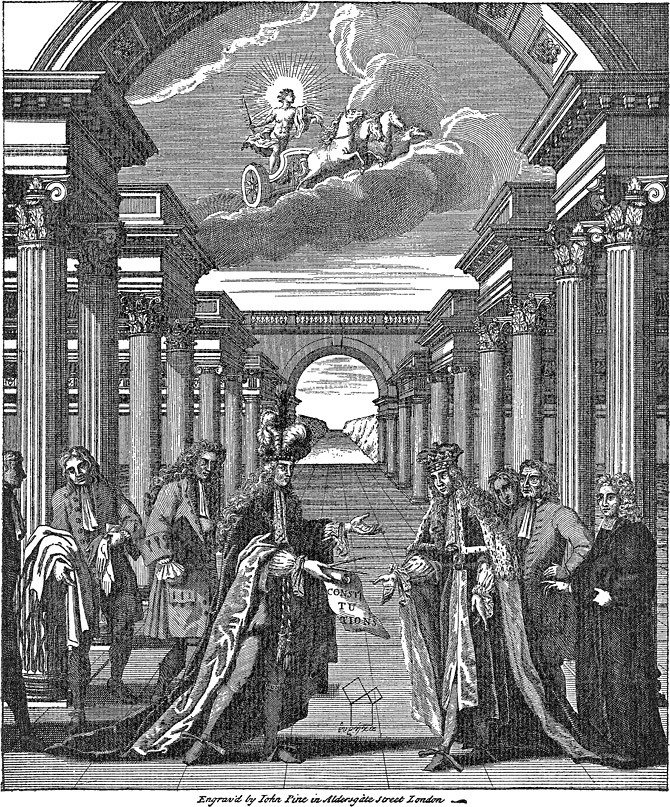
This Lodge became so influential and important, that in the Inventory of 1663, and also in later ones, the names of the “Accepted Masons” are delared to be exhibited “in a faire enclosed frame with a lock and key.” In the same Inventory was also “One book of the constitutions which Mr. Flood gave,” and which was described in a subsequent list of 1676 as “the constitutions of the Accepted masons,” as distinct from “One book of the Ancient Constitutions and Orders” of the Company. The Inventory of 1722 is still more explicit, the Constitutions of the Company being entered as of the year 1481, and the other “A Book wrote on parchment and bound or stitched in parchment containing an account of the Antiquity Rise and Progress of the Art and Mystery of Masonry.” This latter was doubtless a MS. of the “Old Charges” but unfortunately it has not been heard of since the year 1839, when it is said to have contained “113 annals of the antiquity &c. of Masonry.” The “Phillipps MSS” Nos 1 and 2 would answer to this description, and the first-noted has the name of Mr. Richard Bankes, a Member of the Masons’ company, on the cover; the date of its caligraphy, however, does not answer, being of about the middle of the 17th century, therefore not old enough. Though not the original, which was doubtless much older, and used in the reception of the “Accepted Masons,” it may be an exact transcript. The “G.W. Bain MS” has also an equal claim to be considered a representative of the missing book, having a similar text and qualifications. there are also other MSS with a different text from the “Phillipps,” which may be copies of the original document, having the “New Articles,” such as the “Grand Lodge MS No. 2,” and the “Harleian No. 1942.” These later regulations are quite suggestive of the rules in force for the “Accepted Masons,” the term “Acception” is mentioned, and neophytes are termed “Accepted Free-Masons,” while Certificates were provided just as in later times.

It is quite likely that the Company dropping the prefix “Free,” and the speculative branch becoming independent, led to the union of the two prefixes as Free and Accepted Masons.
This is the Lodge that was visited by Elias Ashmole in 1682, for which he received a Summons, and which assembled in the Masons’ Hall, London, when six gentlemen were admitted into the Fellowship, four of whom were members of the Company. Nine of the “Acception” or Lodge attended, besides Ashmole, who says he was “the Senior Fellow among them.” No particulars whatever of the ceremony are afforded, but subsequently they all dined “at the charge of the new-accepted Masons.” All the nine Fellows were members of the Company, including the Master and the two Wardens.

It will thus be seen, that not a few customs of later days were anticipated in the 17th century, such as the use of Masonic Certificates to aid in visitation, the issue of Lodge Summonses, masons’ marks used after the signatures, Essays and Intenders, as well as the promotion of good-fellowship.

The “General Regulations” of the Grand Lodge at London, printed in the year 1723, were for the use of “the Lodges in and about London and Westminster,” being thus originally a Metropolitan organisation. At the time they were printed, there was a older authority at work in the City of York, as a “time immemorial” Grand Lodge, whose preserved records date from 1705, but the Grand Lodge was a very old one at that time.

In Ireland, in like manner, there was a Grand Lodge holding its meetings in the Metropolis of that Country from 1725, and no doubt earlier; also a District or Grand Lodge, quite distinct, though not essentially different, assembling at Cork, for the Province of Munster, and having subordinate Lodges. these surely were anticipated in the 17th century by the Metropolitan Lodge of Scotland, which Masonically in olden time, governed the City, and “Mother Lodge Kilwinning,” which was in charge of quite a large district, and authorised dependent Lodges, one of which is the “Canongate Kilwinning” of 1677.

I claim that Edinburgh and Kilwinning were thus, in not a few important respects, the Masonic prototypes of the London and York organisations, as well as of the Dublin and Cork Grand Lodges.
As the Masonic bodies in Ireland adopted the usage of Deacons long before those in England, which officers, nominally at least if not precisely as to duties, had been familiar to Scotland for centuries, it is just possible that Ireland was more indebted to North Britain for its Masonic laws and customs that has hitherto been recognised or acknowledged, and thus proportionately less to England accordingly.

Whilst it is true that the Craft records in England are not so numerous and valuable as those of Scotland, some of the existing minutes and other indications of Masonic activity are of great importance, as already indicated, and though we do not know when and by whom these 17th century Lodges were originally started or constituted, they assuredly had much in common. Judging from the fact that Dr. Desaguliers, Past Grand Master of England, visited the “Lodge of Edinburgh” in 1721, and having been found to be “duly qualified in all points of Masonry, was received as a Brother,” there seems no reason to suppose that Freemasonry of the 17th century in England, as regards essentials, differed from that of Scotland.
Esoterically there is much to be said as to the Lodges in England and Scotland, but that must be reserved to another time. I may note, however, in passing, that the “Mason Word” was acknowledged to be given in Scotland, and dues paid therefore, as late as 1715, and whilst a gratifying reticence is generally observed, an incomplete minute of 1702 at Haughfoot requires very careful consideration. It reads “of entrie as the apprentice did. Leaving out (the common juudge - Probably an operative “test”) they then whisper the word as before, and the Master Mason grips his hand in the ordinary way.”

It does not appear to me that this entry calls for any remark just now, as it tells its own tale consistently with other records, in relation to the simplicity of the Masonic ceremonial at that time.

The Presbytery of Kelso in 1652 sustained the action of the Rev. James Ainslie in becoming a Freemason, declaring that “there is neither sinne nor scandale in that word” -- i.e., the “Mason Word”.

Along with the “Harleian MS” (No. 2054, British Museum), is a scrap of paper, which cites, “several words and signs of a free Mason” as a portion of an obligation, this MS of the “Old Charges” is in the handwriting of Randle Holme (born 1627), the author of the “Academy of Harmony”, printed in 1688, wherein he says, “I Cannot but Honour the Fellowship of the Masons because of its Antiquity; and the more as being a Member of that Society, called Free-Masons.”
The Oath that was taken by the Brethren during this period, as given in various copies of the “Old Charges” &c., is not indicative of the separate degrees of the post Grand Lodge era.
A remarkable Register of gentlemen and others, with the MS just referred to - Harleian No. 2054 - states what each “giue for to be a free Mason.” This is also in the handwriting of the same Randle Holme, and apparently belonged to a speculative Lodge at Chester.

The references to the Craft in Plot’s “Natural History of Staffordshire,” published in 1686, are of a most important character, and should be carefully studied, as they concern admissions into the Fraternity, the reading of the “Old Charges”, with prominent portions of their text, and the early history of the Society.

There are many ways of proving the existence of the Craft during the seventeenth century, but the foregoing must suffice for the present, the evidence being so plentiful, that is quite embarrassing to make a selection. It cannot, in my opinion, be questioned, that modern Grand Lodges are the direct representatives of the old Lodges previously existing, many of which still continue working.

The records of one Scottish family offer eloquent testimony, to the continuous working of the Craft for centuries, as enshrined in the valuable Perth Charter, and in the “Lodge of Edinburgh” records. From these documents the following facts are gleaned. John Mylne came to Perth from the “North Countrie” and became the King’s Master Mason and Master of the “Lodge at Scone” -- now No. 3 Scotland. He was succeeded by his son, whose name is mentioned in the remarkable “Contract” of 1658, who by His Majesty’s desire entered “King James the sixt as ffreeman, measone and fellow craft.” His third son John was a member of the “Lodge of Edinburgh,” and Master Mason to Charles I., 1631-6; John Mylne the younger, his eldest son, succeeding, became in 1633 a Fellow Craft in No. 1, and was Deacon eleven times within thirty years. Alexander Mylne was entered an apprentice to his uncle in 1653, and was made a fellow-craft in 1660, becoming Warden in 1663-4, and Deacon several times later on. then William Mylne was entered an apprentice in 1721, and was Master in 1735, representing the Lodge at the formation of the Grand Lodge of Scotland the following year, and holding the office of Grand Treasurer from 1737 to 1755. Another William was elected and initiated in the same Lodge in 1750, and a Robert Mylne became a member in 1754, receiving the three degrees in that year. He died in 1811 and “was buried in St. Paul’s Cathedral, having been surveyor to that edifice for fifty years.” With his decease, terminated the family’s connection with the “Lodge of Edinburgh”, which had extended through five successive generations, and for a still longer period as craftsmen.

There are two Lodges of the pre Grand Lodge era, which also overlap that important period, which really require whole Papers to themselves, to do their proceedings anything like justice. A few words about each of these will fitly conclude my Address.

The records of the old Alnwick Lodge were brought to the notice of the Craft by me in 1871, and are of special value, not only because of their antiquity, but also in relation to their text. As with so many of these venerable Lodges, its origin is unknown, but it may be accepted as of the 17th century. A copy of the “Old Charges” precedes the “Orders to be observed by the company and Fellowship of Free Masons, att A Lodge held att Alnwick Septr 29 1701 being the General head meeting day.” Apprentices had to be entered and be given their “Charge” within “one whole Year after” admission, and on the expiry of their term of seven years were “Admitted or Accepted butt upon the feast of St. Michaell the Archangell.” The Master and Wardens were elected by the members, and the frequent entries “made free”, “made free Masons” or “made free brothers” are very suggestive and important. On 20th January, 1708, it was ordered that no member “should appear at the Lodge to be kept on St. John’s Day in Christmas without his appron & Common Square fixt in the Belt,” and to be similarly attired on attending Church on that day, when a special sermon was to be preached. Although the Lodge was active far on in the 18th century, it never, so far as is known, joined the Grand Lodge of England, although a Warrant issued by that Body in 1779 for Alnwick may have been applied for by some of its Brethren. It is of special interest to remember that on Christmas Day in 1755, Mr. “George Henderson of Alnwick. visiting Bro from Canongate Kilwinning Lodge” is duly noted in the minutes; he was initiated in the northern Lodge in 1751, receiving the two higher degrees on Nov 20th 1754. There is no mention of separate Masonic ceremonies in the minutes, 1703 to 1756, and the Lodge was operative from first to last, the proceedings of the modern Grand Lodge and its subordinate Lodges being entirely ignored.

The old operative Lodge at Swalwell, in its early records, had much in common with its senior of Alnwick, its “Orders of Antiquity” and its “Apprentice and General Orders” being virtually reproductions of still earlier “Old Charges.” the three “ffraternal signs” are mentioned, and the minutes generally from the third decade of the 18th century are of considerable value and interest. the members accepted a Charter from the Grand Lodge of England in 1735, being now, and for a long time past, known as the :Lodge of Industry,” No. 48 Gateshead. It was thus another link in the union between the Grand Lodge and its operative ancestors.
It is the fashion of some to raise objections to our claim as being “ancient”, as well as “free and accepted” Masons, but I trust that the facts herein submitted, will “at once and for ever” prove, that our beloved Society is fully entitled to the antiquity so long assumed by the Fraternity.


Wm. James Hughan
“Dunscore”
Torquay,
Jan 19th, 1904

A List of Works that should be consulted in confirmation of the Address.


· “Alnwick MS.” -- Reproduction and Transcript; 1895
· “Ars Quatuor Coronatorum”; 1886-1903. With the “Masonic Reprints,” Vols I to VI.
· Crawley’s “Caementaria Hibernica. 1725-1807; 1895-1900.
· Conder’s “The Hole Craft and Fellowship of Masonry” 1894.
· Gould’s “History of Freemasonry”; 1882-87.
· Gould's “Concise History of Freemasonry;” 1903
· Hughan’s “Old Charges”; 1872 and 1895.
· Hughan's “Masonic Sketches and Reprints”; 1871.
· Hughan's “Masonic Register”; 1878.
· Lyon’s “History of the Lodge of Edinburgh, No. 1”; 1873 and 1900.
· Mackenzie’s “History of the Canongate Kilwinning Lodge, No. 2”; 1888.
· Rylands’ “Freemasonry in the Seventeenth Century”; 1881.
· Smith’s “History of the Ancient Masonic Lodge of Scoon and Perth”; 1898 (Crawford Smith)
· Smith’s “History of the Old Lodge of Dumfries”; 1892.
· Spencer’s “Old Masonic Constitutions”; 1871.
· Todd and Whytehead’s “Ancient York Masonic rolls”; 1894.
· Transactions “Lodge of Research,” No 2049 Leicester; 1892-1903.
· Transactions “Humber Installed Masters” Lodge No. 2494 Hull; 1882-1903.
· Transactions “Sussex Association for Masonic Research”; 1899-1902.
· Vernon’s “History of Freemasonry in Roxburghshire, Peebles and Selkirkshire”; 1893.
· Watson’s Reproductions of the “Old Charges” and “Library Reprints”.
· Wylie’s “History of Mother Lodge Kilwinning”; 1878.

Brother Hughan having intimated his willingness to answer any questions suggested by the Paper, several Brethren took advantage of the opportunity. A list of these questions and Bro. Hughan’s replies thereto are appended.


What brought about the decline of the operative Lodges?
Their inability to preserve or continue the monopoly so long exercised by them. “Cowans” increased in spite of all regulations and efforts to the contrary; the Masters gradually lost their exclusive powers, and towards the end of the 17th century it became evident, that the Building monopolies and close Corporations of the Freemasons’ Lodges had seen their day. It was not the speculatives that caused the decline of the operative Lodges, but the causes came from within.


For what reasons and with what motives did the speculatives originally join the old operative Lodges?
I really cannot tell for certain but can only conjecture. Probably mainly from friendly feelings towards the operatives, and to exhibit or manifest an interest in their welfare. The funds were increased by gentlemen joining, and the Lodges were made all the more popular, by the admission of the local squires and others of means in the neighbourhood of a Lodge. It was a secret Society that was thus joined, and this may have led some to seek admission, from the mystery surrounding the Initiation ceremony. The esoteric character of the Craft has been a source of wonder and curiosity to outsiders for many centuries, and especially for the reputation it has long enjoyed of preserving valuable secrets connected with the Rosicrucian’s, etc.

Does not the fact that all the copies of the “Old Charges” are of English origin, go to prove that Lodges of Masons existed in England earlier than in Scotland?
I do not think so, but only that the traditional history emanated from South Britain. My opinion is, that the Freemasonry of which our Society is a lineal descendant, was formed, but not known when or where, by the Cathedral Builders and their ecclesiastical employers, hence the religious character of the introductory portion of the Manuscript Constitutions, of which we have specimens from the 15th century.

What is known of the early history of the Lodges which formed the London Grand Lodge in 1717?
No records of any of the “Four Old Lodges” have been made known, of a date prior to the London Grand Lodge era it is probable that the “Lodge of Antiquity,” the senior of the “time immemorial” quartet, was a continuation of the Lodge which met under the wing of the Masons’ Company, and know as the “Acception” visited by Ashmole in 1682, and subsequently dropped by the Company. if the valuable “Antiquity MS” of the “Old Charges” of 1686, was in the possession of the ancient Lodge at that time, it dates back the “Antiquity” beyond that ascribed to it in the “Engraved List” of 1729, which was 1691. the second of the quartette on the Register was dated 1712, while the others had no dates affixed. “Multi Paucis” (1764 circa) states that the Master and Wardens of six Lodges assembled at the Apple-Tree in 1716, when it was agreed to revive “their Quarterly Communications”. Certainly the earlies “Engraved List” (1723-4) partly confirms this view of the matter, as the junior of the historic quartette is placed in the fifth space, the fourth being occupied by a Lodge at “The Cheshire Cheese in Arundell Street,” of which we know absolutely nothing more.


Are there not traditions of pre-1717 Lodges in various parts of the South of England?
There are, but to my mind they have not been traced; save the probability of petitioners for the early Lodges have been Masons prior to the formation of the London Grand Lodge.

What’s known of the Lodge which appears in the 1734 List as “No. 65 St. Rooks Hill near Chicester. constituted in the reign of Julius Caesar”?
The Lodge at St. Rook’s Hill, a few miles from Chicester is dated 1730 on the Register. It met once a year only. Nothing is known of its history prior to 1730, and but little since. It was erased from the list in 1754. It is interesting to note, that at the Grand Lodge held March 2nd 1732, “the petition of Brother Edward hall, a Member of the Lodge at the Swan, in Chicester, being there made a Mason by the late Duke of Richmond, six and thirty years ago, and now recommended by the present Duke of Richmond, as a proper object of the Charity of Free and Accepted masons, was read.” This Lodge was constituted in the year 1724 as No. 31, but doubtless was at work many years before, as with several other Lodges in England, which subsequently joined the Grand Lodge.

vendredi 4 janvier 2008

Un Tartan Universal para Masones (Escoceses)

by Anne C. Gilmour & Ridgely H. Gilmour, 33°

Ill. Bros. Ridge Gilmour, PGM, Jeff Chretien, PGM, and Kelly Hansel model the Freemason’s Universal Tartan as kilts. (Photo by William Hall, 32°

In 2004 the Grand Lodge of Utah sponsored the design and production of a tartan fabric that would represent Freemasonry in Utah as well as elsewhere. Scottish tartan plaids have been used for centuries by Scottish clans as a means of identifying and unifying families across that country. This tartan was designed with the family of Freemasonry in mind.

Anne Carroll Gilmour, an internationally known weaver specializing in traditional Scottish Tartan weaving, designed the pattern and submitted it to the Scottish Tartans Authority in Perthshire, Scotland, for registration. The pattern was deemed unique, and a Registration Certificate issued. A mill in Forfar, Scotland, was then commissioned to weave the cloth in bulk.

Above: A bolt of the Freemason’s Universal Tartan.

The colors in the cloth were carefully chosen to represent the various Masonic family organizations including but not limited to the Blue Lodge, Scottish Rite, York Rite, Shriners, Job’s Daughters, DeMolay, Eastern Star, Daughters of the Nile, and more.

The main field of blue in a prominent pivotal position represents the dome of the universe as in Blue Lodge Masonry. The dominance of royal purple in the opposite pivotal field represents Scottish Rite Masonry, York Rite Masonry, Job’s Daughters, and many other Masonic organizations. The prominent red cross carries with it much symbolism used throughout Masonry. You will also see represented the colors of the five points of the Eastern Star, red, white, blue, green, and gold/yellow, as well as related colors connected with the Social Order of the Beauceant, the White Shrine of Jerusalem, the Daughter’s of the Nile, and many others.


Freemasons Universal Tartan

http://www.srmason-sj.org/web/journal-files/Issues/jul-aug06/gilmour.html


jeudi 3 janvier 2008

La Masoneria Moderna y Las Constituciones de Anderson

La Francmasonería moderna (especulativa) nace en 1717 en Londres por lo reunión de cuatro grandes logias que crearon la primera Gran Logia: La Gran Logia Unidad de Inglaterra. En la actualidad tres de esa cuatro Logias fundadora existen : Antiquity No. 2, The Lodge of the Rummer and Grapes (ahora llamada Royal Somerset House and Inverness Lodge No. 4) y The Lodge at the Apple Tree Tavern (ahora llamada Lodge of Fortitude and Old Cumberland No. 12). Simultáneamente, le fue confiado al Pastor Anderson la tarea de actualizar las viejas bases góticas de la Orden. Este trabajo fue sometido a una comisión de catorce hermanos sabios en diciembre 1721, la cual dio su aprobación en marzo de 1722. El libro de las Constituciones fue impreso por primera vez en enero de 1723.

El texto mas conocido de las Constituciones es también aquel contiene el mas alto valor ideológico, curiosamente tanto para los miembros de la Orden como para sus opositores, sin olvidar aquellos miembros de la Mas:. irregular, y dice :
un Mas:. tiene la obligación, por su misma persona, de obedecer las leyes morales, y si comprende bien el Arte, no sera jamas un estúpido ateo ni un libertino irregular. Esta claro que la lectura de esta frase muestra que la Mas:. funda su bases sobre la creencia de un Dios y en la tolerancia de la diversidad de creencias y religiones.

En regla general, la Mas:. Reg:., inspirada por las Constituciones de Anderson, se basa en 12 puntos :

1- La Mas:. es una Frat:. iniciatica la cual tiene como fundamento fe en el G:.A:.D:.U:.
2- La Mas:. tiene como fundamento de la Frat:. a los antiguos deberes.
3- La Mas:. recibe miembros que sean hombre libres y respetables comprometidos con los ideales de paz, amor u Frat:.
4- La Mas impulsa el perfeccionamiento de sus miembros y de la humanidad
5- La Mas:.impone a sus miembros la practica de rituales y simbolismos par el acceso a un conocimiento para una vida espiitual e iniciatica
6- La Mas:. impone a sus miembros el respeto de las opiniones y creencias
7- Los Juramentos se realizan sobre el V:.L:.S:.
8- Los MMas:. se congregan en LLog:.
9- Los MMas:. solo deben admitir hombres respetable, discretos y leales
10- Las MMas:. promueven en Log:. el amor por la patria, obediencia de las leyes, siendo el trabajo el primer deber de todo ser humano
11- Los MMas deben contribuir al brillo de la Orden.
12- Los MMas:. se deben los unos a los otros : proteccion fraterna en toda circunstancia

Cine y Mas:.

QQ HH Todos

2008 ha llegado!! Iniciemos con toda tranquilidad con un Post el cual presenta una serie de referencia cinematográficas con contenido Masónico. Esta lista de películas es gentilmente compartida por la
Gran Logia de la Columbia Britanica y Yucon. En esta lista encontramos peliculas bien conocidas como : The Man Who Would Be King (1975), Murder by Decree (1979), National Treasure (2004), From Hell (2001) etc... La Mas:. tambien es divertida.


.·. .·. .·.
_____________________

Across the Pacific (1942)
Humphrey Bogart is an American Army officer expelled on false charges of treason. In a
shipboard scene, ju-jitsu exercises performed by Chinese sailors are compared to the initiatory nature of Freemasonry. Mary Astor, Sydney Greenstreet. Directed by John Huston. USA, English. *

The Affair of the Diamond Necklace (2001)
Christopher Walken plays Cagliostro, self-styled "the Grand Master of the Illuminati", while Jonathan Pryce, as Bishop Rohen, hides his personal correspondence behind a panel in a desk decorated with masonic symbols. Hilary Swank, Jonathan Pryce, Adrien Brody, Brian Cox, Joely Richardson, Christopher Walken. Directed by Charles Shyer, written by John Sweet. Drama R 117 min., USA, English. Technicolor. *

L'Âge d'or (1930)
To avoid arrest, Gaston Modot, as "the Man", produces a special delegate certificate, given to him by the International Goodwill Society. Although not immediately recognizable by the non-mason, it clearly displays a masonic design with an all-seeing eye in a radiant glory, two pillars with globes as well as three candlesticks on a checkerboard flooring. [
00:28:10] Directed by Luis Buñuel, written by Luis Buñuel, Salvador Dalí. Gaston Modot, Lya Lys, Caridad de Laberdesque, Max Ernst, Josep Llorens Artigas, Lionel Salem, Germaine Noizet, Bonaventura Ibáñez. 60 min. France, French. Black and White, Mono. *

American Gangster (2007)
Ted Levine, as Det. Lou Toback, wears a masonic lapel pin [
0:13:18]. Directed by Ridley Scott, written by Steven Zaillian and Mark Jacobson. Denzel Washington, Russell Crowe, Chiwetel Ejiofor, Josh Brolin, Lymari Nadal, Ted Levine, Roger Guenveur Smith, John Hawkes, RZA, Yul Vazquez, Malcolm Goodwin, Ruby Dee, Ruben Santiago-Hudson, Carla Gugino, Skyler Fortgang. 157 min. USA, English, Colour, Dolby.

Anatomie (2000)
A student member of
the Anti-Hippocratic Society—"a cross between the Freemasons and a college fraternity with old rituals, a lodge, the whole thing"—starts a killing spree that ends with the death of the Grand Master and the exposure of the society. Franka Potente, Benno Fürmann, Anna Loos, Sebastian Blomberg, Holger Speckhahn, Traugott Buhre. Directed and written by Stefan Ruzowitzky. AKA: Anatomy. 103 min. Germany, German / Latin. Colour, Dolby. (Horror) *


El Ángel exterminador "The Exterminating Angel" (1962)
Perhaps Luis Buñuel's most surreal and allegorical film, there is one scene where, in a crowded room, two characters give each other what appears to be the sign of the Fellowcraft degreee [00:18:00]. Later one asks the other for the name of his lodge. The other replies that it is Dawn Lodge No. 21. At a later point, one of the men lets out a cry that another man then explains is the masonic call for help. [01:18:00] While these two are specific masonic references, the story itself can be interpreted as a rebirth or resurrection story incorporating sacrifice and ritual. Directed by Luis Buñuel, written by Luis Buñuel. Silvia Pinal, Enrique Rambal, Claudio Brook, José Baviera, Augusto Benedico, Antonio Bravo, Jacqueline Andere , César del Campo, Rosa Elena Durgel, Lucy Gallardo, Enrique Garcia Álvarez , Ofelia Guilmáin, Nadia Haro Oliva, Tito Junco, Xavier Loya. 95 min.
Mexico, Spanish, Black and White, Mono.


The Ant Bully (2006)
Lucas's grandmother, who fears alien abduction, leaps out of her customized rocking chair to reveal an obviously masonic square and compasses. Why is it there? Perhaps only to attract the attention of websites such as this. [
00:18:00] Directed by John A. Davis, written by John A. Davis, John Nickle (book). Julia Roberts, Nicolas Cage, Meryl Streep, Paul Giamatti, Zach Tyler, Regina King, Bruce Campbell, Lily Tomlin, Cheri Oteri, Larry Miller, Allison Mack, Austin Majors, Ricardo Montalban, Myles Jeffrey, Jake T. Austin. 88 min. USA, English. Colour, Dolby. (Animation) *


Arachnophobia (1990)
The opening scene of the small town where the main story takes place frames a welcome sign incorporating logos for Rotary International, Freemasonry and the Lions Club. [
00:17:44] Note the similarity to the welcome sign in Overboard. Directed by Frank Marshall, written by Don Jakoby, Al Williams. Jeff Daniels, Harley Jane Kozak, John Goodman, Julian Sands, Stuart Pankin, Brian McNamara, Mark L. Taylor, Henry Jones, Peter Jason, James Handy, Roy Brocksmith, Kathy Kinney, Mary Carver, Garette Ratliff Henson, Marlene Katz. 103 min, USA, English Colour, Dolby. *


Are You a Mason? (1915)
Based on the play
Die Logenbrüder in which two non-masons attempt to convince others that they are freemasons. Also produced on Broadway by Leo Ditrichstein. John Barrymore, Helen Freeman, Charles Dixon, Harold Lockwood. Directed by Thomas N. Heffron, written by Leo Ditrichstein (play) Eve Unsell. USA, English. Black and White, Silent. (Comedy) .


Are You a Mason? (1934)
Sonnie Hale, Robertson Hare, Davy Burnaby, Gwyneth Lloyd, Bertha Belmore, Joyce Kirby. Directed by Henry Edwards, written by Leo Ditrichstein (play) Emanuel Lederer (play).
70 min. UK, English. Black and White, Mono. (Comedy).


Bad Boys II (2003)
Narcotics officers Mike Lowrey (Will Smith) and Marcus Bennett (Martin Lawrence) use a tile installer’s truck, with a square and compasses sticker on the back door [
00:18:00]. Martin Lawrence, Will Smith, Jordi Mollà, Gabrielle Union, Peter Stormare. Directed by Michael Bay, written by George Gallo, Marianne Wibberley. 150 min. USA, English, Colour (Comedy). *


Big Fish (2003)
Ed Bloom, played by Ewan McGregor, is given the key to the city and a parade when he leaves his small hometown. The parade consists entirely of Ed, his travelling companion, Karl, and six Shriners in mini-cars [
00:30:00]. Directed by Tim Burton, written by Daniel Wallace (novel) John August (screenplay) Ewan McGregor, Albert Finney, Billy Crudup, Jessica Lange. (Drama / Fantasy / Comedy). 124 min., USA, English. Colour, Dolby. *


Bird (1988)
A biography of jazz musician Charlie "Yardbird" Parker. In a cemetery scene the camera pans across a
row of monuments, one of which displays a square and compasses. Forest Whitaker, Diane Venora. Produced and directed by Clint Eastwood, written by Joel Oliansky. 160 min., USA, English. Colour. *


Bobby Bumps Starts a lodge (1916)
Young Bobby Bumps plays a trick on his friend who wants to be initiated into his lodge. When his friend outsmarts him and saves his life, they both agree to be
initiated into the lodge together. Reference is made to a lodge apron, riding the goat and the third degree. Bray Productions, Inc. Paramount Pictures. Directed by Earl Hurd (d. 1940). Produced by J. R. Bray. piano score composed and performed by Philip Carli. 5:15 min/24 fps. Released September 28, 1916. 1 reel of 1 (ca. 615 ft.) : silent animation, b&w ; 35 mm. *


The Celebration. "Dogme 1, Festen" (1998)
[00:23:49 - 00:24:09] Helge Klingenfeldt to his youngest son Michael: "I've been asked to inquire whether you are interested in the lodge. I don't see you as one of the brethren, I must say. But Christian has told Preben you're doing well. And as Christian is not interested, you may expect to be invited — to join the Freemasons. Strike while the iron is hot. There is a long...." The camera pulls back to one of Helge’s associates: "He could make something of himself." Helge finishes by saying: "We have to help you get on." Helge (Henning Moritzen) is revealed to have molested two of his children, driving one to suicide. Michael (Thomas Bo Larsen), a violent quick-tempered married man with three children, is revealed to have had an affair with one of his parents' maids, Michelle. Henning Moritzen, Paprika Steen, Thomas Bo Larsen, Ulrich Thomsen. Produced by Birgette Hald, written by Thomas Vinterberg.
Danish, 106 min. Colour, Mono. 1998 (Drama) *


Conspiracy Theory (1997)
Mel Gibson, as
programmed assassin turned cabbie, Jerry Fletcher, says "I mean George Bush knew what he was saying when he said New World Order, you remember those fatal words, New World Order? Well he was a 33rd degree mason you know and an ex director of the CIA." [00:01:40]. Julia Roberts, as justice department lawyer, Alice Sutton, says: "I suppose they have a secret handshake." [00:38:29]. Other references, if intended as such, are less obvious. Mel Gibson, Julia Roberts, Patrick Stewart. Directed by Richard Donner, written by Brian Helgeland. Warner Bros. 129 min., USA, English, Colour (Drama). *


Coup de torchon (1981)
In 1938 French West Africa, Lucien Cordier, as Philippe Noiret, describes his father: "He’s one of those people who believes there’s only one answer to every problem and one of those who blames everything on Jews and Freemasons." [00:59:54] Directed by Bertrand Tavernier, written by Jean Aurenche Bertrand Tavernier.
Philippe Noiret, Isabelle Huppert, Jean-Pierre Marielle, Stéphane Audran, Eddy Mitchell, Guy Marchand, Irène Skobline. Also Known As Clean Up. 128 min. France, French, Colour. *


Cremaster Cycle (1995-2002)
A set of five art films with
numerous masonic references. Directed by Matthew Barney, written by Matthew Barney. Cremaster 1 (1995): Marti Domination, Gemma Bourdon Smith, Kathleen Crepeau. 40 min. USA, English. Colour, Mono. , Cremaster 2 (1999), Cremaster 3 (2002), Cremaster 4 (1994), Cremaster 5 (1997): Ursula Andress, Matthew Barney, Joanne Rha. 55 min. USA, Hungarian, Colour.


The Da Vinci Code (2006)
Tom Hanks, as Robert Langdon, stands in front of a
display of "religious" symbols, including a masonic square and compasses in the bottom left corner. This image is a promotional still. Langdon makes a passing reference to Freemasonry near the end of the film. Directed by Ron Howard, written by Akiva Goldsman (screenplay) Dan Brown (novel). Tom Hanks, Audrey Tautou, Ian McKellen, Jean Reno, Paul Bettany, Alfred Molina, Jürgen Prochnow, Jean-Yves Berteloot, Etienne Chicot, Jean-Pierre Marielle, Marie-Françoise Audollent, Rita Davies, Francesco Carnelutti, Seth Gabel, Shane Zaza. 149 min. Country: USA, English / French / Latin. Colour


Dolores Claiborne (1995)
Delores'
bank manager—who is wearing a square and compasses lapel pin— tells her that her husband has emptied their joint savings account. Kathy Bates as Dolores Claiborne, Jennifer Jason Leigh, Judy Parfitt, Christopher Plummer. Directed by Taylor Hackford, written by Stephen King (book), screenplay by Tony Gilroy. 132 min., USA, English. Dolby Digital, Technocolour. *


Elmer Gantry (1960)
Edward Andrews as real estate agent,
George F. Babbitt, says, "Do you realize that practically every American president was a mason and a Protestant?" He later exclaims, "I'm in business! I'm a thirty-second degree mason!" Burt Lancaster, Jean Simmons, Shirley Jones. Directed and written by Richard Brooks. Novel by Sinclair Lewis (1885-1951). Fox, MGM, 146 min. USA, English, Colour. *


The End of Days (1999)
Arnold Schwartzenegger plays a former police officer who carries an amulet. At one point he says "Now this amulet is from a masonic order in the former sub-heredom of the Vatican Knights, the Knights of the Holy See. They await the return of the dark angel to earth." Also, during the opening titles
Elephis Lévi’s baphomet can be briefly seen. Gabriel Byrne, Kevin Pollak, Rod Steiger. Directed by Peter Hyams, written by Andrew W. Marlowe. *


Erin Brockovich (2000)
The
cornerstone of the Barstow Courthouse displays a square and compasses. Although there is a report that in a later scene a friend of Erin tells her that her husband is out at a lodge meeting, your editor has been unable to find this scene in the DVD release. Julia Roberts, David Brisbin, Dawn Didawick, Albert Finney. Directed by Steven Soderbergh, written by Susannah Grant. 130 min. USA, English, Colour. *


Flushed Away (2006)
The Toad, villain of the film, wears a ring, seen at [
00:16:00] and [00:20:00]. It may represent a masonic square and compasses but unfortunately it is not shown in sharp enough focus to be sure. Directed by David Bowers and Sam Fell, weitten by Sam Fell (story) and Peter Lord. Hugh Jackman, Kate Winslet, Ian McKellen, Jean Reno, Bill Nighy, Andy Serkis, Shane Richie, Kathy Burke, David Suchet, Miriam Margolyes, Rachel Rawlinson, Susan Duerden, Miles Richardson, John Motson, Douglas Weston. 84 min. UK / USA, English. Color, Dolby. *


From Hell (2001)
Implicates the Craft as being responsible for the Whitechapel murders in London. The
many masonic images and references places this movie in the catagory of intentional anti-masonry. Johnny Depp, Heather Graham, Ian Holm. Directed by Albert Hughes, based on a graphic novel written by Alan Moore, Eddie Campbell. USA, English, 121 min., Colour. *


Gattopardo, Il "The Leopard" (1963)
Father Pirrone exclaims: "You nobles will come to an arrangement with the liberals...and even the masons? At the expense of the Church? [
00:17:00]. Directed by Luchino Visconti. Written by Giuseppe Tomasi Di Lampedusa (novel), Suso Cecchi d'Amico (screenplay). Burt Lancaster, Claudia Cardinale, Alain Delon. 205 min. Italy / France. Italian. Technicolor, Mono. (Drama) *


Ghosts of Mississippi (1996)
In a depiction of a true story, convicted murderer, Byron "Delay" De La Beckwith (1920/11/09-2001/01/21)—played by James Wood—is shown driving a car with a
Shriners symbol attached to his rear view mirror and, in several scenes, wearing a Shriners lapel pin. His victim, NAACP field secretary Medger W. Evers (1925/07/02-1963/06/12), is shown in his coffin with his Order of Elks fez placed on his chest. In real life, Byron De La Beckwith received his Master Mason degree in Greenwood Lodge No. 35, Mississippi, on 30 September, 1954. He was expelled from the lodge on 2 January, 1978. Alec Baldwin, Whoopi Goldberg, James Woods. Directed by Rob Reiner, written by Leo Colick, Columbia Pictures & Castle Rock Entertainment. USA *


The Godfather Part III (1990)
This fictional film
echoes several events of the 1981 Italian P2 scandal. Directed by Francis Ford Coppola, written by Mario Puzo, Francis Ford Coppola. Al Pacino, Diane Keaton, Talia Shire, Andy Garcia, Eli Wallach, Joe Mantegna, George Hamilton, Bridget Fonda, Sofia Coppola. 162 min / USA:169 min (video version). USA, English / Italian. Technicolor, 70 mm 6-Track (70 mm prints) / Dolby SR (35 mm prints). *


Gypsy (1962)
Based on Gypsy Rose Lee’s autobiography, the first half hour of this movie emphasizes the reliance Rose Hovick placed on her claimed
fraternal associations. Centre place is given to the Elks and Buffalo, but the Shriners are mentioned in the song, "Some People". Directed by Mervyn LeRoy, written by Arthur Laurents (play) Gypsy Rose Lee (book). Rosalind Russell, Natalie Wood, Karl Malden, Paul Wallace, Betty Bruce, Parley Baer, Harry Shannon, Morgan Brittany, Ann Jillian, Diane Pace, Faith Dane, Roxanne Arlen, Jean Willes, George Petrie, Ben Lessy. 143 min. USA, English. Technicolor, Stereo. *


Help! (1965)
Ringo Starr asks an Indian restaurant doorman, "You know what this ring means?"
He replies, "Freemason?" Ringo Starr, Paul McCartney, John Lennon, George Harrison, Leo McKern. Directed by Richard Lester, written by Charles Wood, Marc Behm. *


Hollywood Homicide (2003)
Keith David as Leon, Detective Joe Gavilan’s supervising officer, wears a masonic ring [
00:55:50], clearly seen on the hand he’s holding the phone with. Harrison Ford, Josh Hartnett, Lena Olin, Bruce Greenwood, Isaiah Washington, Lolita Davidovich, Keith David, Master P, Dwight Yoakam, Martin Landau, Lou Diamond Phillips, Gladys Knight. Directed by Ron Shelton, written by Robert Souza, Ron Shelton. 116 min. USA, English. Colour, Dolby Digital (Action) *


How to Marry a Millionaire (1953)
When Betty Grable returns from what she had expected to be an Elks Lodge convention [
00:50:04], she tells Lauren Bacall that she had got married. Lauren exclaims "Not to that Shriner!" [01:40:05]
Betty Grable (1916/12/18 - 1973/07/02), Marilyn Monroe, Lauren Bacall (1924/09/16 - ), David Wayne, Rory Calhoun, Cameron Mitchell, Alexander D'Arcy, Fred Clark (1914/03/19 - 1968/12/05), William Powell. Directed by Jean Negulesco, written by Zoe Akins , Dale Eunson. 95 min. USA, English. Technicolor, 4-Track Stereo (Western Electric Sound System).
(Comedy) *


How to Succeed in Business Without Really Trying (1967)
Near the movie’s end Robert Morse sings: "Now, you may join the Elks, my friend, and I may join the Shriners. And other men may carry cards as members of the Diners. Still others wear a golden key or small Greek letter pin but I have learned there’s one great club that all of us are in. There is a brotherhood, of man. A benevolent brotherhood of man. A noble tie that binds all our hearts and minds into a brotherhood of man." [
01:51:52] Directed by David Swift, written by Shepherd Mead (novel). Abe Burrows (play). Robert Morse, Michele Lee, Rudy Vallee, Anthony ’scooter' Teague, Maureen Arthur. 121 min. USA, English. Colour, Mono. *


In Cold Blood (1967)
During a police interrogation, accused murderer Dick Hickock says: "Everybody’s got a tattoo. Only you people call them clubs. Elks, Masons, Boy Scouts. Salute. High sign. Low sign. Secret this and secret that." [01:29:00] A different line appears in the
original book. Robert Blake, Scott Wilson. Directed and written by Richard Brooks, Truman Capote (book). 134 minutes. USA, English, B&W. *


Into the Wild (2007)
A masonic lodge hall has been reported in an early scene. Directed by Sean Penn, written by Jon Krakauer, Sean Penn. Emile Hirsch, Marcia Gay Harden, William Hurt, Jena Malone, Brian Dierker, Catherine Keener.
140 min., USA, English / Danish, Colour, Dolby. [unconfirmed]


Jack the Ripper (1988)
Sherlock Holmes is shown giving a sign of an Entered Apprentice to the Chief of the Metropolitan Police; other references throughout the movie. Michael Caine as Inspector Frederick Abberline. [unconfirmed]


Kiss Me, Stupid (1964)
Hanging on a cupboard door in a roadhouse whore's trailer is a large Shriner crest. [
00:46:00]. Directed by Billy Wilder, written by Anna Bonacci, I.A.L. Diamond. Dean Martin, Kim Novak, Ray Walston, Felicia Farr, Cliff Osmond, Barbara Pepper, Skip Ward, Doro Merande, Bobo Lewis, Tom Nolan, Alice Pearce, John Fiedler, Arlen Stuart, Howard McNear, Cliff Norton, Mack Gray, Mel Blanc, John Fiedler. 125 min. USA, English, Black and White, Mono. *


League of Extraordinary Gentlemen (2003)
The
square and compasses appear four times: twice in close-ups of an oversize masonic ring worn by the Phantom, a villain who tries to ignite a world war at the turn of the last century in order to create a market for his futuristic weapons and once on the office doors of the founder of the League, "M", who is later revealed to be the same person. No other reference is made to Freemasonry. A shot of the square and compasses—four big shiny ones that flash and sparkle in the light as the door on which they're mounted closes—also appears in the trailer. Sean Connery. Based on a graphic novel of the same name by Alan Moore, who also gave us From Hell. *


Like Water for Chocolate [Como agua para chocolate] (1992)
A
masonic funeral is briefly seen through a window. Later, the young doctor sho���ws the main character a drawing incorporating the square and compasses and an all-seeing eye [00:37:35] . Marco Leonardi, Tita Regina Torné, Iván Martínez. Directed by Alfonso Arau, written by Laura Esquivel. Novel by Laura Esquivel. 123 min. Mexico : Spanish *


Lone Star (1996)
Corrupt sheriff Charley Wade, played by Kris Kristofferson, is identified as a freemason by his ring as the movie begins. The ring is clearly seen in a later scene as he accepts a bribe [
00:08::38]. Stephen Mendillo, Stephen J. Lang, Chris Cooper. Directed and written by John Sayles. USA, English, 135 min. (Drama/Mystery). *


Lost Horizon (1937)
British diplomat Robert Conway and three others crash land in the Himalayas, and are rescued by the people of the mysterious, Eden-like valley of Shangri-la.
Edward Everett Horton is interrupted, as he exclaims, "I've just finished translating one of the most interesting old tablets you can imagine. It told me all about the origin of the masonic symbols and science and...." Ronald Colman as Conway, Edward Everett Horton (1886/03/18 - 1970/09/29) as Alexander P. Lovett. Directed by Frank Capra, written by James Hilton & Robert Riskin. 132 min., USA, English, b&w. *


Mad Max Beyond Thunderdome (1985)
Edwin Hodgeman as Dr. Dealgood, the announcer introducing the fight between Max and Blaster wears a
square and compasses image on his shirt front. Frank Thring, as the Collector, wears a lapel jewel that may be from a concordant masonic body. Mel Gibson, Tina Turner, Bruce Spence. Directed by George Millar. Australia/USA, English, 107 min. Colour, Dolby (Action/SF). *


Magnolia (1999)
Just before gameshow host Jimmy Gator, played by Philip Baker Hall, goes on stage, Burt Ramsey, played by Ricky Jay—who is wearing a masonic ring—asks him, "You with me, Jimmy?" Jimmy says, "The book says we may be through with the past but the past ain't through with us." to which Burt replies, "We met upon the level and we're parting on the square."
[00:51:23]


While studying in the public library, gameshow contestant Stanley Specter, played by Jeremy Blackman, has a stack of books, one of which is Mackey’s History of Freemasonry.


Almost masonic is the stage backdrop which includes a number of symbols one of which is a compasses over a laurel.


Of no masonic significance, it is a curious piece of forshadowing when a stagehand briefly flashes a cue card with "Exodus 8:12" written on it. The movie ends with a rain of frogs.


Jason Robards, Philip Seymour Hoffman, Julianne Moore, Tom Cruise, Philip Baker Hall, Melora Waters, John C. Reilly, Jeremy Blackman, William H. Macy. Directed by Paul Thomas Anderson, written by Paul Thomas Anderson. 188 min. USA, English. Colour (DeLuxe), Dolby Digital. R. (Drama) *


The Majestic (2001)
Unrelated to the story, the square and compasses symbol can be seen once on
a mausoleum in the cemetery scene and once on a building on Main Street in the later half of the movie. Jim Carrey, Bob Balaban, Jeffrey DeMunn, Hal Holbrook, Laurie Holden, Martin Landau. Directed by Frank Darabont, written by Michael Sloane. 152 min. USA, English. Technicolor, Dolby Digital. (Drama / Romance). *


The Man (2005)
The murderous, gun-dealing villain of the story, Joey Trent, is shown in two scenes wearing a masonic ring. In the first scene [
00:13:32] the ring is unnaturally twisted on his finger so that it directly faces the camera. In the second scene [01:12:40] the ring is visible in close-up shots of Joey pointing a pistol during a stand-off with Samuel L. Jackson's character, Derrick Vann. The positioning is too blatant to be unintentional but whether the intent was anti-masonic or marketing is impossible to determine. The motives of any film-maker who includes masonic references in a movie produced since the launch of the web are suspect. Directed by Les Mayfield, written by Jim Piddock, Margaret Oberman. Samuel L. Jackson, Eugene Levy, Luke Goss, Miguel Ferrer, Susie Essman, Anthony Mackie, Gigi Rice, Rachael Crawford, Philip Akin, Christopher Murray, Joel S. Keller, John Hemphill, Kathryn Greenwood, Carrie Cain-Sparks, George Ghali. 83 min. USA, English. Color, Dolby. *


The Man Who Would Be King (1975)
Based on a
Rudyard Kipling story. Mercenary soldiers convince Kafiristan tribespeople that they are gods after discovering masonic symbols on religious artifacts. Sean Connery, Michael Caine. Directed by John Huston. 129 min. UK/USA, English, Colour. (Drama/Action). *


Miami Vice (2006)
Colin Farrell and Jamie Foxx are parked in front of a Scottish Rite hall.
[01:53:00]


Directed by Michael Mann, written by Michael Mann, Anthony Yerkovich. Colin Farrell, Jamie Foxx, Li Gong, Luis Tosar, Naomie Harris, Elizabeth Rodriguez, Justin Theroux, Ciarán Hinds, Barry Shabaka Henley, Domenick Lombardozzi, Isaach De Bankolé, John Ortiz, Eddie Marsan, Ana Cristina De Oliveira, John Hawkes. 134 min. Germany / USA, English / Spanish / Cree. Colour, Dolby. *


Midnight in the Garden of Good and Evil (1997)
The appearance of a square and compasses is reported but details are unavailable.
Also see entry for John Berendt's novel.


Directed by Clint Eastwood, written by John Berendt (book) John Lee Hancock (screenplay). John Cusack, Kevin Spacey, Jack Thompson, Irma P. Hall, Jude Law, Alison Eastwood, Paul Hipp, Lady Chablis, Dorothy Loudon, Anne Haney, Kim Hunter, Geoffrey Lewis, Richard Herd, Leon Rippy, Bob Gunton. 155 min. USA, English / French. Technicolor, Dolby. [Unconfirmed]


Mississippi Burning (1988)
Willem Dafoe as Agent Alan Ward talks to Gene Hackman as Agent Rupert Anderson:


There’s something wrong with him. He’s too confident.
What? Did you see the wedding photograph?
No. Why?
His three pals are ushers. They had this way of hooking their thumbs in their belts with the three fingers pointing down, like that.
So what is that? Some sort of masonic thing?
No. K K K. [
00:46:21]


Directed by Alan Parker, written by Chris Gerolmo. Gene Hackman, Willem Dafoe, Frances McDormand. 128 min. USA, English. Colour (DeLuxe), Dolby (Drama) *


Murder at the Gallop (1963)
Charles 'Bud' Tingwell as Inspector Craddock and Margaret Rutherford as Miss Marple stand in front of a fireplace which displays a square and compasses.
[00:24:00]


Directed by George Pollock. Agatha Christie (novel), James P. Cavanagh (screenplay). Margaret Rutherford, Stringer Davis, Robert Morley, Flora Robson, Charles 'Bud' Tingwell, Gordon Harris, Robert Urquhart, Katya Douglas, James Villiers, Noel Howlett, Finlay Currie, Duncan Lamont, Kevin Stoney. 81 min. UK, English. Black and White, Mono


Murder by Decree (1979)
Sherlock Holmes investigates London’s most infamous case, Jack the Ripper. As he investigates, he finds that the Ripper has friends in high places, implicating freemasons. Christopher Plummer, James Mason. Directed by Bob Clark. *


Nashville (1975)
While Ronee Blakley sings at an outdoors concert the camera pans across the audience, several of whom are
Shriners. David Arkin, Barbara Baxley, Ned Beatty, Karen Black, Ronee Blakley, Timothy Brown, Keith Carradine, Geraldine Chaplin, Robert DoQui, Shelley Duvall, Allen Garfield, Henry Gibson, Scott Glenn, Jeff Goldblum, et al. Directed by Robert Altman, written by Joan Tewkesbury. 1975. 159 min. USA, English, Metrocolour, Stereo (Drama). *


National Treasure (2004)
Benjamin Franklin Gates, played by Nicholas Cage, descends from a family of treasure-seekers who've all hunted for the same thing: a war chest hidden by the American founding fathers. This movie is yet another fictional attempt to link the freemasons, the Knights Templar and the founding of the USA through
the use of various symbols, also seen in the film's trailer. Nicolas Cage, Justin Bartha, Sean Bean, Diane Kruger, Harvey Keitel, Christopher Plummer, Jon Voight. Directed by Jon Turteltaub, written by Ted Elliott, E. Max Frye. USA, English. Colour, Stereo. (Adventure). Movie trailer found at bvim-qt.vitalstream.com. *


National Treasure Two: Book of Secrets (2007)
Artifact hunter Benjamin Franklin Gates, again played by Nicholas Cage, returns in this adventure sequel. Masonic references are limited mainly to citations of a secret correspondence between Queen Victoria and Confederate General
Albert Pike and a suggestion that French freemason Frederic Bartholdi incorporated a clue to the treasure in his design of the Statue of Liberty because "Masons built clues into everything." Nicolas Cage, Justin Bartha, Ed Harris, Jon Voight, Diane Kruger, Harvey Keitel, Helen Mirren. Directed by Jon Turteltaub, written by Gregory Poirier, Cormac Wibberley, Marianne Wibberley, Ted Elliott, Terry Russio. USA, English. Colour, Stereo. (Adventure).


Nostradamus (1994)
Masonic symbols have been reportedly seen on documents handed to Nostradamus. [unconfirmed]
Directed by Roger Christian, written by Piers Ashworth (story) and Roger Christian. Tchéky Karyo, F. Murray Abraham, Rutger Hauer, Amanda Plummer, Julia Ormond, Assumpta Serna, Anthony Higgins, Diana Quick, Michael Gough, Maia Morgenstern, Magdalena Ritter, Bruce Myers, Leon Lissek, Michael Byrne, Stefan Patoli.
119 min. France / UK / Germany / Romania. English. Color.


Once a Mason (1919)
Sidney Drew, Mrs. Sidney Drew. Directed by Mrs. Sidney Drew, Sidney Drew, written by Mrs. Sidney Drew, Sidney Drew. USA, English. Black and White, Silent. (Comedy). [Mrs. Sidney Drew (18/04/1890- 3/11/1925), née: Lucille McVey: AKA: Lucille M. Drew, Lucille McVey, Jane Morrow), appeared in 54 films, wrote 29, directed 25 and produced one.
Sidney Drew (28/08/1863- 09/04/1919) appeared in 160 films, directed 143, and wrote 53.]


Overboard (1987)
In the beginning of the movie, as Dean (Kurt) is driving into town, the camera pans past the "Welcome to "Elk Cove" sign. Attached is a very obvious
large blue masonic emblem. Goldie Hawn, Kurt Russell, Edward Herrmann, Katherine Helmond, Michael G. Hagerty, Roddy McDowall. Directed by Garry Marshall, written by Leslie Dixon . 106 min / 112 min (TCM print). USA, English. Metrocolour, Dolby. *


Paper Moon (1973)
Ryan O'Neal plays a travelling con-artist, Moses Pray, who sells "deluxe, gold-embossed personalized" Bibles to recently bereaved widows. His first sale after meeting Tatum O'Neal, as Addie Loggins, is to a widow whose late husband's services were held at "Masonic Lodge No. 721" [
00:18:00]. Directed by Peter Bogdanovich, writing credits Joe David Brown (novel) Alvin Sargent (screenplay). Ryan O'Neal, Tatum O'Neal, Madeline Kahn, John Hillerman, P.J. Johnson, Lee Fulton, James N. Harrell, Lila Waters, Noble Willingham, Bob Young, Jack Saunders, Jody Wilbur, Liz Ross, Yvonne Harrison, Dorothy Price. 102 min. USA, English. Black and White, Mono. Based on Addie Pray, Joe David Brown. Boston, G. K. Hall, 1971. 529 p. 25 cm. ISBN: 0816160090. *


Peggy Sue Got Married (1986)
A
masonic lodge hall sign with square and compasses can be seen early in the movie. Kathleen Turner, Nicolas Cage. Directed by Francis Ford Coppola. *


Revelation (2001)
The Knights Templar are searching for an ancient relic, the Loculus, so that they can resurrect Christ. Lord Martel tells the story of a masonic order called the Knights Templars (sic); a Knights Templar ceremony, several all-seeing eye symbols and pentagrams are depicted. A TV newscast mentions an illegal masonic order called the P2 CIA; the camera then pans to the word "Masonic" on a newspaper headline. The overall theme of the
movie is anti-masonic. Terence Stamp, James D'Arcy, Natasha Wightman, Liam Cunningham, Heathcote Williams, Derek Jacobi. Directed by Stuart Urban, written by Frank Falco (idea) Stuart Urban. 111 min. UK, English, Colour (DeLuxe), Dolby Digital. Romulus Films, Overseas Filmgroup (Drama/Fantasy). *


Road Rage (1999)
A car chase scene includes vehicles driving past a bus painted with Shriners' symbols. Yasmine Bleeth, Ellen Carson, Eddie Madden, Jim Carson.Directed by Deran Sarafian, written by Brian L. Ross, David Taylor.
92 min. USA. English, Colour, 1999 (Thriller) [Unconfirmed]


Rosewood (1997)
Based on an actual incident in 1923, this movie has played fast and loose with the historical facts but none-the-less presents a scathing and realistic indictment of the times. While there is evidence of a masonic angle, the movie gives it far too much prominence.
Masonic symbols are prominently displayed in several scenes. Jon Voight, Ving Rhames, Don Cheadle. Directed by John Singleton, written by Gregory Poirier. 140 min. USA, English. Technicolor, Dolby Digital. R. (Action/Drama). *


The Searchers (1956)
In a scene where Wayne rides into a Camanche camp after a battle, one of the dead Camanches is lying sprawled face up, wearing a blue cloth apron, similar in size to a
masonic apron, with white ribbons sewn in the shape of a square and compasses. John Wayne, Jeffrey Hunter, Vera Miles, Ward Bond, Natalie Wood. Directed by John Ford, Script by Frank Nugen. USA. English, 120 min., Colour (Western). *


Secrets (1982)
A group of girls at a boarding school re-enact a masonic ritual based on one girl’s deceased father’s ritual book. Helen Lindesey, Anne Campbell-Jones, Daisy Cockburn, Directed by Gavin Millar.
British. *


The Shop on Main Street (1965)
In 1943 Czechoslovakia a police officer warns a nightclub crowd that they will have no mercy on "Jew-Bolshevists, Freemasons, plutocrats and other riff-raff." [
01:43:20] (Obchod na Korze) Idá Kaminská, Josef Kroner. Directed by Ján Kadár & Elmar Klos, screenplay by L. Grosman, Ján Kadár & Elmar Klos. 1965. 125 min. Czechoslovakia, Czechoslovakian, Filmové Studio Barrandov. B&W, mono. *


Short Circuit (1986)
Early in the film, shortly after a military demonstration, a computor programmer is shown working on a keyboard. A close-up of his hands typing on the keyboard shows a masonic ring on his left hand. Directed by John Badham, written by Brent Maddock, S.S. Wilson. Ally Sheedy, Steve Guttenberg, Fisher Stevens, Austin Pendleton, G.W. Bailey, Brian McNamara, Tim Blaney, Marvin J. McIntyre, John Garber, Penny Santon, Vernon Weddle, Barbara Tarbuck, Tom Lawrence, Fred Slyter, Billy Ray Sharkey.
98 min. USA, English, Color, Dolby. [unconfirmed]


Slacker (1991)
A montage of interconnected conversations and monologues, one is a rant on UFO conspiracies, one is on Kennedy assassination conspiracies and one later
conversation is about the freemasons:


"The reason these guys are being forgotten though, is that they're not freemasons. The masons are the one’s that control history. Look at it, every... every president but one: mason. Every man that’s walked on the moon... thirty-third degree mason. I mean, look at the Warren commission, a Shriner convention without go-carts."


"Exactly. The slate of American history needs to be wiped clean. We need to start all over again. Let’s put Larry Fieman in the history books. Let’s put Squeaky Fromme on the one dollar bill."


"Least we ought to get that masonic pyramid bullshit off the back." [01:14:40]


Directed and written by Richard Linklater. Espresso Czar/Masonic Malcontent played by Dan Kratochvil. 97 min. USA, English. Colour, Ultra Stereo *


Spartan (2004)
Curtis (Derek Luke) : "My name’s Curtis."
Scott (Val Kilmer): "Do I need to know that? If I want camaraderie, I'll join the masons."
Tia Texada, Derek Luke, Val Kilmer. Directed by David Mamet, written by David Mamet. 106 min. USA / Germany, English / Russian / Swedish.
Colour, Dolby Digital. (Thriller)


Take Me Out To The Ball Game (1948)
The lyrics in the closing number, a reprise of
Strictly USA, end with: "Like the annual Elks convention / Like masonic halls or firemen’s balls / Like honeymooning at Niagara Falls / They're really here to stay / Cause it’s strictly USA." Directed by Busby Berkeley, produced by Arthur Freed, written by Gene Kelly and Stanley Donen. Frank Sinatra, Esther Williams, Gene Kelly, Betty Garrett. Metro-Goldwyn-Mayer, Loew’s Incorporated. 93 min. USA. English, Technicolor. (Musical / Comedy) *


They All Laughed (1981)
Patti Hansen, as Sam (Deborah Wilson), drives a taxi with a square and compasses pendant hanging from her rear view mirror. Directed by Peter Bogdanovich, written by Peter Bogdanovich Blaine Novak. Audrey Hepburn, Ben Gazzara, Patti Hansen, John Ritter, Dorothy Stratten, Blaine Novak, Linda MacEwen, George Morfogen, Colleen Camp, Sean H. Ferrer, Glenn Scarpelli, Vassili Lambrinos, Antonia Bogdanovich, Sashy Bogdanovich, Sheila Stodden.
115 min. USA, English. Colour, Mono. [Unconfirmed]


Things to Come (1936)
In the year 1936 a global war begins. This war drags out over many decades ... Raymond Massey as John Cabal/Oswald Cabal makes a reference to "The brotherhood of efficiency. The freemasonry of science." [
00:36:00] A later reference to "our children’s children" and the framing of many shots by pillars or arches is not necessarily significant. Edward Chapman as Pippa Passworthy/Raymond Passworthy, Ralph Richardson as The Boss, Margaretta Scott as Roxana/Rowena. Directed by William Cameron Menzies, Writing credits: H.G. Wells (also novel The Shape of Things to Come) AKA: The Shape of Things to Come. UK, English, 100 min., b&w, Mono. (Sci-Fi). *


Tombstone (1993)
A retelling of the gunfight at the OK Corral and its aftermath. Jon Tenney, as John Behan, Cochise County Sheriff wears
a square and compasses watchfob. Buck Taylor, as Turkey Creek Jack Johnson, wearing a square and compasses pendant responds to Val Kilmer’s Doc Holliday saying he has no friends by saying, "Hell, I've got lots of friends." Kurt Russell, Val Kilmer. Directed by George P. Cosmatos, written by Kevin Jarre. USA, English. 130 min. Dolby, Technicolor (Western). *


True Grit (1969)
Kim Darby’s character, Matty, on viewing her recently deceased father in a coffin in a funeral parlour, tells the farm hand, "When you get home, you put him in a better coffin and you bury him in a mason’s apron." [00:13:12] This line is based on the 1968
novel by Charles Portis. John Wayne, Glen Campbell, Robert Duvall. Directed by Henry Hathaway. USA, English. Colour (Western). *


U-Turn (1997)
A married real estate salesman, Jake McKenna played by Nick Nolte, in Superior Arizona later married his daughter by his Apache mistress then hires a gambler on the run to kill her. He wears a masonic ring, seen in a close-up [
00:41:05]. Directed by Oliver Stone, written by John Ridley. Sean Penn, Nick Nolte, Jennifer Lopez, Powers Boothe, Claire Danes, Joaquin Phoenix, Jon Voight, Billy Bob Thornton. 125 min, France / USA, English. Technicolor, Dolby Digital. (Drama). *


War and Peace (1968)
Andre : "Have you made your mind at last? The Imperial Guard or diplomacy?"


Pierre Bezukhov : "I don't know yet. I don't like to be either. He must be a freemason, anyway. [00:09:40, Part 1]


Countess : "You're flirting with him too."


Natasha Rostova : "No, he [Pierre] is a freemason." [00:05:41, Part 2]


Voyna i mir (1968) (War and Peace). Directed by Sergei Bondarchuk, written by Sergei Bondarchuk, Vasili Solovyov . Irina Gubanova, Antonina Shuranova, Sergei Bondarchuk, Liudmila Savelieva, Sergei Bondarchuk, Vyacheslav Tikhonov, Anastasiya Vertinskaya, Irina Skobtseva, Vassily Lanovoy, Oleg Efremov. 4 parts, 403 min. Soviet Union, Russian. Sovcolor, Dolby (DVD). *


Who Framed Roger Rabbit (1988)
Roger hides out in a theatre house, and sees a news reel highlighting a Shriners parade. Bob Hoskins, Christopher Lloyd, Joanna Cassidy, Charles Fleischer, Kathleen Turner (uncredited). Directed by Robert Zemeckis, written by Gary K. Wolf (novel) Jeffrey Price. 103 min. USA, English. Colour (DeLuxe), Sound Mix: 70 mm 6-Track (70 mm prints) / Dolby (35 mm prints). (Cartoon) *


What Planet Are You From? (2000)
Garry Shandling plays Harold Anderson who is an extraterrestrial working as a loans officer in a bank. His manager, Don Fisk played by Richard Jenkins, wears a masonic lapel pin. He is also wearing a wedding band and claims to be having an affair with one of his employees. Directed by Mike Nichols, Written by Garry Shandling, Michael Leeson. Garry Shandling, Annette Bening, John Goodman, Greg Kinnear, Ben Kingsley. 104 min. USA, English. Colour (DeLuxe), Dolby Digital / SDDS. R (Comedy). *


What’s Eating Gilbert Grape (1993)
A masonic ring is worn by Ken Carver [01:07:06];, a small-town Insurance salesman trying too hard to be an attentive father. Johnny Depp, Leonardo DiCaprio, Juliette Lewis. Directed by Lasse Hallström, written by Peter Hedges. 118 min. USA, English. Colour, Dolby. (Drama) *


Z (1969)
When a pacifist and humanitarian speaker, "the Deputy", is attacked on his way to a peace rally, an unidentified man joins the rally organizers to help get him to safety and then justifies his presence by saying: "I'm a mason."] [
00:24:50]. Directed by Costa-Gavras, written by Vassilis Vassilikos (novel) Jorge Semprún. Yves Montand, Irene Papas, Jean-Louis Trintignant, Jacques Perrin, Charles Denner, François Périer, Pierre Dux, Georges Géret, Bernard Fresson, Marcel Bozzuffi, Julien Guiomar, Magali Noël, Renato Salvatori, Habib Reda, Clotilde Joano. 127 min, Algeria / France, French. Eastmancolor, Mono. Visa de Contrôle Cinámatographique No. 34.695.