VI VERI VENIVERSUM VIVUS VICI


dimanche 19 juillet 2009

Freemasonry and movies (update)


Across the Pacific (1942)
Humphrey Bogart is an American Army officer expelled on false charges of treason. In a
shipboard scene, ju-jitsu exercises performed by Chinese sailors are compared to the initiatory nature of Freemasonry. Mary Astor, Sydney Greenstreet. Directed by John Huston. USA, English. *


The Affair of the Diamond Necklace (2001)
Christopher Walken plays Cagliostro, self-styled "the Grand Master of the Illuminati", while Jonathan Pryce, as Bishop Rohen, hides his personal correspondence behind a panel in a desk decorated with masonic symbols. Hilary Swank, Jonathan Pryce, Adrien Brody, Brian Cox, Joely Richardson, Christopher Walken. Directed by Charles Shyer, written by John Sweet. Drama R 117 min., USA, English. Technicolor. *


L'Âge d'or (1930)
To avoid arrest, Gaston Modot, as "the Man", produces a special delegate certificate, given to him by the International Goodwill Society. Although not immediately recognizable by the non-mason, it clearly displays a masonic design with an all-seeing eye in a radiant glory, two pillars with globes as well as three candlesticks on a checkerboard flooring. [
00:28:10] Directed by Luis Buñuel, written by Luis Buñuel, Salvador Dalí. Gaston Modot, Lya Lys, Caridad de Laberdesque, Max Ernst, Josep Llorens Artigas, Lionel Salem, Germaine Noizet, Bonaventura Ibáñez. 60 min. France, French. Black and White, Mono. *

American Gangster (2007)
Ted Levine, as Det. Lou Toback, wears a masonic lapel pin [
0:13:18]. Directed by Ridley Scott, written by Steven Zaillian and Mark Jacobson. Denzel Washington, Russell Crowe, Chiwetel Ejiofor, Josh Brolin, Lymari Nadal, Ted Levine, Roger Guenveur Smith, John Hawkes, RZA, Yul Vazquez, Malcolm Goodwin, Ruby Dee, Ruben Santiago-Hudson, Carla Gugino, Skyler Fortgang. 157 min. USA, English, Colour, Dolby.

Anatomie (2000)
A student member of
the Anti-Hippocratic Society—"a cross between the Freemasons and a college fraternity with old rituals, a lodge, the whole thing"—starts a killing spree that ends with the death of the Grand Master and the exposure of the society. Franka Potente, Benno Fürmann, Anna Loos, Sebastian Blomberg, Holger Speckhahn, Traugott Buhre. Directed and written by Stefan Ruzowitzky. AKA: Anatomy. 103 min. Germany, German / Latin. Colour, Dolby. (Horror) *


El Ángel exterminador "The Exterminating Angel" (1962)
Perhaps Luis Buñuel's most surreal and allegorical film, there is one scene where, in a crowded room, two characters give each other what appears to be the sign of the Fellowcraft degreee [00:18:00]. Later one asks the other for the name of his lodge. The other replies that it is Dawn Lodge No. 21. At a later point, one of the men lets out a cry that another man then explains is the masonic call for help. [01:18:00] While these two are specific masonic references, the story itself can be interpreted as a rebirth or resurrection story incorporating sacrifice and ritual. Directed by Luis Buñuel, written by Luis Buñuel. Silvia Pinal, Enrique Rambal, Claudio Brook, José Baviera, Augusto Benedico, Antonio Bravo, Jacqueline Andere , César del Campo, Rosa Elena Durgel, Lucy Gallardo, Enrique Garcia Álvarez , Ofelia Guilmáin, Nadia Haro Oliva, Tito Junco, Xavier Loya. 95 min.
Mexico, Spanish, Black and White, Mono.


The Ant Bully (2006)
Lucas's grandmother, who fears alien abduction, leaps out of her customized rocking chair to reveal an obviously masonic square and compasses. Why is it there? Perhaps only to attract the attention of websites such as this. [
00:18:00] Directed by John A. Davis, written by John A. Davis, John Nickle (book). Julia Roberts, Nicolas Cage, Meryl Streep, Paul Giamatti, Zach Tyler, Regina King, Bruce Campbell, Lily Tomlin, Cheri Oteri, Larry Miller, Allison Mack, Austin Majors, Ricardo Montalban, Myles Jeffrey, Jake T. Austin. 88 min. USA, English. Colour, Dolby. (Animation) *


Arachnophobia (1990)
The opening scene of the small town where the main story takes place frames a welcome sign incorporating logos for Rotary International, Freemasonry and the Lions Club. [
00:17:44] Note the similarity to the welcome sign in Overboard. Directed by Frank Marshall, written by Don Jakoby, Al Williams. Jeff Daniels, Harley Jane Kozak, John Goodman, Julian Sands, Stuart Pankin, Brian McNamara, Mark L. Taylor, Henry Jones, Peter Jason, James Handy, Roy Brocksmith, Kathy Kinney, Mary Carver, Garette Ratliff Henson, Marlene Katz. 103 min, USA, English Colour, Dolby. *


Are You a Mason? (1915)
Based on the play
Die Logenbrüder in which two non-masons attempt to convince others that they are freemasons. Also produced on Broadway by Leo Ditrichstein. John Barrymore, Helen Freeman, Charles Dixon, Harold Lockwood. Directed by Thomas N. Heffron, written by Leo Ditrichstein (play) Eve Unsell. USA, English. Black and White, Silent. (Comedy) .


Are You a Mason? (1934)
Sonnie Hale, Robertson Hare, Davy Burnaby, Gwyneth Lloyd, Bertha Belmore, Joyce Kirby. Directed by Henry Edwards, written by Leo Ditrichstein (play) Emanuel Lederer (play).
70 min. UK, English. Black and White, Mono. (Comedy).


Bad Boys II (2003)
Narcotics officers Mike Lowrey (Will Smith) and Marcus Bennett (Martin Lawrence) use a tile installer’s truck, with a square and compasses sticker on the back door [
00:18:00]. Martin Lawrence, Will Smith, Jordi Mollà, Gabrielle Union, Peter Stormare. Directed by Michael Bay, written by George Gallo, Marianne Wibberley. 150 min. USA, English, Colour (Comedy). *


Big Fish (2003)
Ed Bloom, played by Ewan McGregor, is given the key to the city and a parade when he leaves his small hometown. The parade consists entirely of Ed, his travelling companion, Karl, and six Shriners in mini-cars [
00:30:00]. Directed by Tim Burton, written by Daniel Wallace (novel) John August (screenplay) Ewan McGregor, Albert Finney, Billy Crudup, Jessica Lange. (Drama / Fantasy / Comedy). 124 min., USA, English. Colour, Dolby. *


Bird (1988)
A biography of jazz musician Charlie "Yardbird" Parker. In a cemetery scene the camera pans across a
row of monuments, one of which displays a square and compasses. Forest Whitaker, Diane Venora. Produced and directed by Clint Eastwood, written by Joel Oliansky. 160 min., USA, English. Colour. *


Bobby Bumps Starts a lodge (1916)
Young Bobby Bumps plays a trick on his friend who wants to be initiated into his lodge. When his friend outsmarts him and saves his life, they both agree to be
initiated into the lodge together. Reference is made to a lodge apron, riding the goat and the third degree. Bray Productions, Inc. Paramount Pictures. Directed by Earl Hurd (d. 1940). Produced by J. R. Bray. piano score composed and performed by Philip Carli. 5:15 min/24 fps. Released September 28, 1916. 1 reel of 1 (ca. 615 ft.) : silent animation, b&w ; 35 mm. *


The Celebration. "Dogme 1, Festen" (1998)
[00:23:49 - 00:24:09] Helge Klingenfeldt to his youngest son Michael: "I've been asked to inquire whether you are interested in the lodge. I don't see you as one of the brethren, I must say. But Christian has told Preben you're doing well. And as Christian is not interested, you may expect to be invited — to join the Freemasons. Strike while the iron is hot. There is a long...." The camera pulls back to one of Helge’s associates: "He could make something of himself." Helge finishes by saying: "We have to help you get on." Helge (Henning Moritzen) is revealed to have molested two of his children, driving one to suicide. Michael (Thomas Bo Larsen), a violent quick-tempered married man with three children, is revealed to have had an affair with one of his parents' maids, Michelle. Henning Moritzen, Paprika Steen, Thomas Bo Larsen, Ulrich Thomsen. Produced by Birgette Hald, written by Thomas Vinterberg.
Danish, 106 min. Colour, Mono. 1998 (Drama) *


Conspiracy Theory (1997)
Mel Gibson, as
programmed assassin turned cabbie, Jerry Fletcher, says "I mean George Bush knew what he was saying when he said New World Order, you remember those fatal words, New World Order? Well he was a 33rd degree mason you know and an ex director of the CIA." [00:01:40]. Julia Roberts, as justice department lawyer, Alice Sutton, says: "I suppose they have a secret handshake." [00:38:29]. Other references, if intended as such, are less obvious. Mel Gibson, Julia Roberts, Patrick Stewart. Directed by Richard Donner, written by Brian Helgeland. Warner Bros. 129 min., USA, English, Colour (Drama). *


Coup de torchon (1981)
In 1938 French West Africa, Lucien Cordier, as Philippe Noiret, describes his father: "He’s one of those people who believes there’s only one answer to every problem and one of those who blames everything on Jews and Freemasons." [00:59:54] Directed by Bertrand Tavernier, written by Jean Aurenche Bertrand Tavernier.
Philippe Noiret, Isabelle Huppert, Jean-Pierre Marielle, Stéphane Audran, Eddy Mitchell, Guy Marchand, Irène Skobline. Also Known As Clean Up. 128 min. France, French, Colour. *


Cremaster Cycle (1995-2002)
A set of five art films with
numerous masonic references. Directed by Matthew Barney, written by Matthew Barney. Cremaster 1 (1995): Marti Domination, Gemma Bourdon Smith, Kathleen Crepeau. 40 min. USA, English. Colour, Mono. , Cremaster 2 (1999), Cremaster 3 (2002), Cremaster 4 (1994), Cremaster 5 (1997): Ursula Andress, Matthew Barney, Joanne Rha. 55 min. USA, Hungarian, Colour.


The Da Vinci Code (2006)
Tom Hanks, as Robert Langdon, stands in front of a
display of "religious" symbols, including a masonic square and compasses in the bottom left corner. This image is a promotional still. Langdon makes a passing reference to Freemasonry near the end of the film. Directed by Ron Howard, written by Akiva Goldsman (screenplay) Dan Brown (novel). Tom Hanks, Audrey Tautou, Ian McKellen, Jean Reno, Paul Bettany, Alfred Molina, Jürgen Prochnow, Jean-Yves Berteloot, Etienne Chicot, Jean-Pierre Marielle, Marie-Françoise Audollent, Rita Davies, Francesco Carnelutti, Seth Gabel, Shane Zaza. 149 min. Country: USA, English / French / Latin. Colour


Dolores Claiborne (1995)
Delores'
bank manager—who is wearing a square and compasses lapel pin— tells her that her husband has emptied their joint savings account. Kathy Bates as Dolores Claiborne, Jennifer Jason Leigh, Judy Parfitt, Christopher Plummer. Directed by Taylor Hackford, written by Stephen King (book), screenplay by Tony Gilroy. 132 min., USA, English. Dolby Digital, Technocolour. *


Elmer Gantry (1960)
Edward Andrews as real estate agent,
George F. Babbitt, says, "Do you realize that practically every American president was a mason and a Protestant?" He later exclaims, "I'm in business! I'm a thirty-second degree mason!" Burt Lancaster, Jean Simmons, Shirley Jones. Directed and written by Richard Brooks. Novel by Sinclair Lewis (1885-1951). Fox, MGM, 146 min. USA, English, Colour. *


The End of Days (1999)
Arnold Schwartzenegger plays a former police officer who carries an amulet. At one point he says "Now this amulet is from a masonic order in the former sub-heredom of the Vatican Knights, the Knights of the Holy See. They await the return of the dark angel to earth." Also, during the opening titles
Elephis Lévi’s baphomet can be briefly seen. Gabriel Byrne, Kevin Pollak, Rod Steiger. Directed by Peter Hyams, written by Andrew W. Marlowe. *


Erin Brockovich (2000)
The
cornerstone of the Barstow Courthouse displays a square and compasses. Although there is a report that in a later scene a friend of Erin tells her that her husband is out at a lodge meeting, your editor has been unable to find this scene in the DVD release. Julia Roberts, David Brisbin, Dawn Didawick, Albert Finney. Directed by Steven Soderbergh, written by Susannah Grant. 130 min. USA, English, Colour. *


Flushed Away (2006)
The Toad, villain of the film, wears a ring, seen at [
00:16:00] and [00:20:00]. It may represent a masonic square and compasses but unfortunately it is not shown in sharp enough focus to be sure. Directed by David Bowers and Sam Fell, weitten by Sam Fell (story) and Peter Lord. Hugh Jackman, Kate Winslet, Ian McKellen, Jean Reno, Bill Nighy, Andy Serkis, Shane Richie, Kathy Burke, David Suchet, Miriam Margolyes, Rachel Rawlinson, Susan Duerden, Miles Richardson, John Motson, Douglas Weston. 84 min. UK / USA, English. Color, Dolby. *


From Hell (2001)
Implicates the Craft as being responsible for the Whitechapel murders in London. The
many masonic images and references places this movie in the catagory of intentional anti-masonry. Johnny Depp, Heather Graham, Ian Holm. Directed by Albert Hughes, based on a graphic novel written by Alan Moore, Eddie Campbell. USA, English, 121 min., Colour. *


Gattopardo, Il "The Leopard" (1963)
Father Pirrone exclaims: "You nobles will come to an arrangement with the liberals...and even the masons? At the expense of the Church? [
00:17:00]. Directed by Luchino Visconti. Written by Giuseppe Tomasi Di Lampedusa (novel), Suso Cecchi d'Amico (screenplay). Burt Lancaster, Claudia Cardinale, Alain Delon. 205 min. Italy / France. Italian. Technicolor, Mono. (Drama) *


Ghosts of Mississippi (1996)
In a depiction of a true story, convicted murderer, Byron "Delay" De La Beckwith (1920/11/09-2001/01/21)—played by James Wood—is shown driving a car with a
Shriners symbol attached to his rear view mirror and, in several scenes, wearing a Shriners lapel pin. His victim, NAACP field secretary Medger W. Evers (1925/07/02-1963/06/12), is shown in his coffin with his Order of Elks fez placed on his chest. In real life, Byron De La Beckwith received his Master Mason degree in Greenwood Lodge No. 35, Mississippi, on 30 September, 1954. He was expelled from the lodge on 2 January, 1978. Alec Baldwin, Whoopi Goldberg, James Woods. Directed by Rob Reiner, written by Leo Colick, Columbia Pictures & Castle Rock Entertainment. USA *


The Godfather Part III (1990)
This fictional film
echoes several events of the 1981 Italian P2 scandal. Directed by Francis Ford Coppola, written by Mario Puzo, Francis Ford Coppola. Al Pacino, Diane Keaton, Talia Shire, Andy Garcia, Eli Wallach, Joe Mantegna, George Hamilton, Bridget Fonda, Sofia Coppola. 162 min / USA:169 min (video version). USA, English / Italian. Technicolor, 70 mm 6-Track (70 mm prints) / Dolby SR (35 mm prints). *


Gypsy (1962)
Based on Gypsy Rose Lee’s autobiography, the first half hour of this movie emphasizes the reliance Rose Hovick placed on her claimed
fraternal associations. Centre place is given to the Elks and Buffalo, but the Shriners are mentioned in the song, "Some People". Directed by Mervyn LeRoy, written by Arthur Laurents (play) Gypsy Rose Lee (book). Rosalind Russell, Natalie Wood, Karl Malden, Paul Wallace, Betty Bruce, Parley Baer, Harry Shannon, Morgan Brittany, Ann Jillian, Diane Pace, Faith Dane, Roxanne Arlen, Jean Willes, George Petrie, Ben Lessy. 143 min. USA, English. Technicolor, Stereo. *


Help! (1965)
Ringo Starr asks an Indian restaurant doorman, "You know what this ring means?"
He replies, "Freemason?" Ringo Starr, Paul McCartney, John Lennon, George Harrison, Leo McKern. Directed by Richard Lester, written by Charles Wood, Marc Behm. *


Hollywood Homicide (2003)
Keith David as Leon, Detective Joe Gavilan’s supervising officer, wears a masonic ring [
00:55:50], clearly seen on the hand he’s holding the phone with. Harrison Ford, Josh Hartnett, Lena Olin, Bruce Greenwood, Isaiah Washington, Lolita Davidovich, Keith David, Master P, Dwight Yoakam, Martin Landau, Lou Diamond Phillips, Gladys Knight. Directed by Ron Shelton, written by Robert Souza, Ron Shelton. 116 min. USA, English. Colour, Dolby Digital (Action) *


How to Marry a Millionaire (1953)
When Betty Grable returns from what she had expected to be an Elks Lodge convention [
00:50:04], she tells Lauren Bacall that she had got married. Lauren exclaims "Not to that Shriner!" [01:40:05]
Betty Grable (1916/12/18 - 1973/07/02), Marilyn Monroe, Lauren Bacall (1924/09/16 - ), David Wayne, Rory Calhoun, Cameron Mitchell, Alexander D'Arcy, Fred Clark (1914/03/19 - 1968/12/05), William Powell. Directed by Jean Negulesco, written by Zoe Akins , Dale Eunson. 95 min. USA, English. Technicolor, 4-Track Stereo (Western Electric Sound System).
(Comedy) *


How to Succeed in Business Without Really Trying (1967)
Near the movie’s end Robert Morse sings: "Now, you may join the Elks, my friend, and I may join the Shriners. And other men may carry cards as members of the Diners. Still others wear a golden key or small Greek letter pin but I have learned there’s one great club that all of us are in. There is a brotherhood, of man. A benevolent brotherhood of man. A noble tie that binds all our hearts and minds into a brotherhood of man." [
01:51:52] Directed by David Swift, written by Shepherd Mead (novel). Abe Burrows (play). Robert Morse, Michele Lee, Rudy Vallee, Anthony ’scooter' Teague, Maureen Arthur. 121 min. USA, English. Colour, Mono. *


In Cold Blood (1967)
During a police interrogation, accused murderer Dick Hickock says: "Everybody’s got a tattoo. Only you people call them clubs. Elks, Masons, Boy Scouts. Salute. High sign. Low sign. Secret this and secret that." [01:29:00] A different line appears in the
original book. Robert Blake, Scott Wilson. Directed and written by Richard Brooks, Truman Capote (book). 134 minutes. USA, English, B&W. *


Into the Wild (2007)
A masonic lodge hall has been reported in an early scene. Directed by Sean Penn, written by Jon Krakauer, Sean Penn. Emile Hirsch, Marcia Gay Harden, William Hurt, Jena Malone, Brian Dierker, Catherine Keener.
140 min., USA, English / Danish, Colour, Dolby. [unconfirmed]


Jack the Ripper (1988)
Sherlock Holmes is shown giving a sign of an Entered Apprentice to the Chief of the Metropolitan Police; other references throughout the movie. Michael Caine as Inspector Frederick Abberline. [unconfirmed]


Kiss Me, Stupid (1964)
Hanging on a cupboard door in a roadhouse whore's trailer is a large Shriner crest. [
00:46:00]. Directed by Billy Wilder, written by Anna Bonacci, I.A.L. Diamond. Dean Martin, Kim Novak, Ray Walston, Felicia Farr, Cliff Osmond, Barbara Pepper, Skip Ward, Doro Merande, Bobo Lewis, Tom Nolan, Alice Pearce, John Fiedler, Arlen Stuart, Howard McNear, Cliff Norton, Mack Gray, Mel Blanc, John Fiedler. 125 min. USA, English, Black and White, Mono. *


League of Extraordinary Gentlemen (2003)
The
square and compasses appear four times: twice in close-ups of an oversize masonic ring worn by the Phantom, a villain who tries to ignite a world war at the turn of the last century in order to create a market for his futuristic weapons and once on the office doors of the founder of the League, "M", who is later revealed to be the same person. No other reference is made to Freemasonry. A shot of the square and compasses—four big shiny ones that flash and sparkle in the light as the door on which they're mounted closes—also appears in the trailer. Sean Connery. Based on a graphic novel of the same name by Alan Moore, who also gave us From Hell. *


Like Water for Chocolate [Como agua para chocolate] (1992)
A
masonic funeral is briefly seen through a window. Later, the young doctor sho���ws the main character a drawing incorporating the square and compasses and an all-seeing eye [00:37:35] . Marco Leonardi, Tita Regina Torné, Iván Martínez. Directed by Alfonso Arau, written by Laura Esquivel. Novel by Laura Esquivel. 123 min. Mexico : Spanish *


Lone Star (1996)
Corrupt sheriff Charley Wade, played by Kris Kristofferson, is identified as a freemason by his ring as the movie begins. The ring is clearly seen in a later scene as he accepts a bribe [
00:08::38]. Stephen Mendillo, Stephen J. Lang, Chris Cooper. Directed and written by John Sayles. USA, English, 135 min. (Drama/Mystery). *


Lost Horizon (1937)
British diplomat Robert Conway and three others crash land in the Himalayas, and are rescued by the people of the mysterious, Eden-like valley of Shangri-la.
Edward Everett Horton is interrupted, as he exclaims, "I've just finished translating one of the most interesting old tablets you can imagine. It told me all about the origin of the masonic symbols and science and...." Ronald Colman as Conway, Edward Everett Horton (1886/03/18 - 1970/09/29) as Alexander P. Lovett. Directed by Frank Capra, written by James Hilton & Robert Riskin. 132 min., USA, English, b&w. *


Mad Max Beyond Thunderdome (1985)
Edwin Hodgeman as Dr. Dealgood, the announcer introducing the fight between Max and Blaster wears a
square and compasses image on his shirt front. Frank Thring, as the Collector, wears a lapel jewel that may be from a concordant masonic body. Mel Gibson, Tina Turner, Bruce Spence. Directed by George Millar. Australia/USA, English, 107 min. Colour, Dolby (Action/SF). *


Magnolia (1999)
Just before gameshow host Jimmy Gator, played by Philip Baker Hall, goes on stage, Burt Ramsey, played by Ricky Jay—who is wearing a masonic ring—asks him, "You with me, Jimmy?" Jimmy says, "The book says we may be through with the past but the past ain't through with us." to which Burt replies, "We met upon the level and we're parting on the square."
[00:51:23]


While studying in the public library, gameshow contestant Stanley Specter, played by Jeremy Blackman, has a stack of books, one of which is Mackey’s History of Freemasonry.


Almost masonic is the stage backdrop which includes a number of symbols one of which is a compasses over a laurel.


Of no masonic significance, it is a curious piece of forshadowing when a stagehand briefly flashes a cue card with "Exodus 8:12" written on it. The movie ends with a rain of frogs.


Jason Robards, Philip Seymour Hoffman, Julianne Moore, Tom Cruise, Philip Baker Hall, Melora Waters, John C. Reilly, Jeremy Blackman, William H. Macy. Directed by Paul Thomas Anderson, written by Paul Thomas Anderson. 188 min. USA, English. Colour (DeLuxe), Dolby Digital. R. (Drama) *


The Majestic (2001)
Unrelated to the story, the square and compasses symbol can be seen once on
a mausoleum in the cemetery scene and once on a building on Main Street in the later half of the movie. Jim Carrey, Bob Balaban, Jeffrey DeMunn, Hal Holbrook, Laurie Holden, Martin Landau. Directed by Frank Darabont, written by Michael Sloane. 152 min. USA, English. Technicolor, Dolby Digital. (Drama / Romance). *


The Man (2005)
The murderous, gun-dealing villain of the story, Joey Trent, is shown in two scenes wearing a masonic ring. In the first scene [
00:13:32] the ring is unnaturally twisted on his finger so that it directly faces the camera. In the second scene [01:12:40] the ring is visible in close-up shots of Joey pointing a pistol during a stand-off with Samuel L. Jackson's character, Derrick Vann. The positioning is too blatant to be unintentional but whether the intent was anti-masonic or marketing is impossible to determine. The motives of any film-maker who includes masonic references in a movie produced since the launch of the web are suspect. Directed by Les Mayfield, written by Jim Piddock, Margaret Oberman. Samuel L. Jackson, Eugene Levy, Luke Goss, Miguel Ferrer, Susie Essman, Anthony Mackie, Gigi Rice, Rachael Crawford, Philip Akin, Christopher Murray, Joel S. Keller, John Hemphill, Kathryn Greenwood, Carrie Cain-Sparks, George Ghali. 83 min. USA, English. Color, Dolby. *


The Man Who Would Be King (1975)
Based on a
Rudyard Kipling story. Mercenary soldiers convince Kafiristan tribespeople that they are gods after discovering masonic symbols on religious artifacts. Sean Connery, Michael Caine. Directed by John Huston. 129 min. UK/USA, English, Colour. (Drama/Action). *


Miami Vice (2006)
Colin Farrell and Jamie Foxx are parked in front of a Scottish Rite hall.
[01:53:00]


Directed by Michael Mann, written by Michael Mann, Anthony Yerkovich. Colin Farrell, Jamie Foxx, Li Gong, Luis Tosar, Naomie Harris, Elizabeth Rodriguez, Justin Theroux, Ciarán Hinds, Barry Shabaka Henley, Domenick Lombardozzi, Isaach De Bankolé, John Ortiz, Eddie Marsan, Ana Cristina De Oliveira, John Hawkes. 134 min. Germany / USA, English / Spanish / Cree. Colour, Dolby. *


Midnight in the Garden of Good and Evil (1997)
The appearance of a square and compasses is reported but details are unavailable.
Also see entry for John Berendt's novel.


Directed by Clint Eastwood, written by John Berendt (book) John Lee Hancock (screenplay). John Cusack, Kevin Spacey, Jack Thompson, Irma P. Hall, Jude Law, Alison Eastwood, Paul Hipp, Lady Chablis, Dorothy Loudon, Anne Haney, Kim Hunter, Geoffrey Lewis, Richard Herd, Leon Rippy, Bob Gunton. 155 min. USA, English / French. Technicolor, Dolby. [Unconfirmed]


Mississippi Burning (1988)
Willem Dafoe as Agent Alan Ward talks to Gene Hackman as Agent Rupert Anderson:


There’s something wrong with him. He’s too confident.
What? Did you see the wedding photograph?
No. Why?
His three pals are ushers. They had this way of hooking their thumbs in their belts with the three fingers pointing down, like that.
So what is that? Some sort of masonic thing?
No. K K K. [
00:46:21]


Directed by Alan Parker, written by Chris Gerolmo. Gene Hackman, Willem Dafoe, Frances McDormand. 128 min. USA, English. Colour (DeLuxe), Dolby (Drama) *


Murder at the Gallop (1963)
Charles 'Bud' Tingwell as Inspector Craddock and Margaret Rutherford as Miss Marple stand in front of a fireplace which displays a square and compasses.
[00:24:00]


Directed by George Pollock. Agatha Christie (novel), James P. Cavanagh (screenplay). Margaret Rutherford, Stringer Davis, Robert Morley, Flora Robson, Charles 'Bud' Tingwell, Gordon Harris, Robert Urquhart, Katya Douglas, James Villiers, Noel Howlett, Finlay Currie, Duncan Lamont, Kevin Stoney. 81 min. UK, English. Black and White, Mono


Murder by Decree (1979)
Sherlock Holmes investigates London’s most infamous case, Jack the Ripper. As he investigates, he finds that the Ripper has friends in high places, implicating freemasons. Christopher Plummer, James Mason. Directed by Bob Clark. *


Nashville (1975)
While Ronee Blakley sings at an outdoors concert the camera pans across the audience, several of whom are
Shriners. David Arkin, Barbara Baxley, Ned Beatty, Karen Black, Ronee Blakley, Timothy Brown, Keith Carradine, Geraldine Chaplin, Robert DoQui, Shelley Duvall, Allen Garfield, Henry Gibson, Scott Glenn, Jeff Goldblum, et al. Directed by Robert Altman, written by Joan Tewkesbury. 1975. 159 min. USA, English, Metrocolour, Stereo (Drama). *


National Treasure (2004)
Benjamin Franklin Gates, played by Nicholas Cage, descends from a family of treasure-seekers who've all hunted for the same thing: a war chest hidden by the American founding fathers. This movie is yet another fictional attempt to link the freemasons, the Knights Templar and the founding of the USA through
the use of various symbols, also seen in the film's trailer. Nicolas Cage, Justin Bartha, Sean Bean, Diane Kruger, Harvey Keitel, Christopher Plummer, Jon Voight. Directed by Jon Turteltaub, written by Ted Elliott, E. Max Frye. USA, English. Colour, Stereo. (Adventure). Movie trailer found at bvim-qt.vitalstream.com. *


National Treasure Two: Book of Secrets (2007)
Artifact hunter Benjamin Franklin Gates, again played by Nicholas Cage, returns in this adventure sequel. Masonic references are limited mainly to citations of a secret correspondence between Queen Victoria and Confederate General
Albert Pike and a suggestion that French freemason Frederic Bartholdi incorporated a clue to the treasure in his design of the Statue of Liberty because "Masons built clues into everything." Nicolas Cage, Justin Bartha, Ed Harris, Jon Voight, Diane Kruger, Harvey Keitel, Helen Mirren. Directed by Jon Turteltaub, written by Gregory Poirier, Cormac Wibberley, Marianne Wibberley, Ted Elliott, Terry Russio. USA, English. Colour, Stereo. (Adventure).


Nostradamus (1994)
Masonic symbols have been reportedly seen on documents handed to Nostradamus. [unconfirmed]
Directed by Roger Christian, written by Piers Ashworth (story) and Roger Christian. Tchéky Karyo, F. Murray Abraham, Rutger Hauer, Amanda Plummer, Julia Ormond, Assumpta Serna, Anthony Higgins, Diana Quick, Michael Gough, Maia Morgenstern, Magdalena Ritter, Bruce Myers, Leon Lissek, Michael Byrne, Stefan Patoli.
119 min. France / UK / Germany / Romania. English. Color.


Once a Mason (1919)
Sidney Drew, Mrs. Sidney Drew. Directed by Mrs. Sidney Drew, Sidney Drew, written by Mrs. Sidney Drew, Sidney Drew. USA, English. Black and White, Silent. (Comedy). [Mrs. Sidney Drew (18/04/1890- 3/11/1925), née: Lucille McVey: AKA: Lucille M. Drew, Lucille McVey, Jane Morrow), appeared in 54 films, wrote 29, directed 25 and produced one.
Sidney Drew (28/08/1863- 09/04/1919) appeared in 160 films, directed 143, and wrote 53.]


Overboard (1987)
In the beginning of the movie, as Dean (Kurt) is driving into town, the camera pans past the "Welcome to "Elk Cove" sign. Attached is a very obvious
large blue masonic emblem. Goldie Hawn, Kurt Russell, Edward Herrmann, Katherine Helmond, Michael G. Hagerty, Roddy McDowall. Directed by Garry Marshall, written by Leslie Dixon . 106 min / 112 min (TCM print). USA, English. Metrocolour, Dolby. *


Paper Moon (1973)
Ryan O'Neal plays a travelling con-artist, Moses Pray, who sells "deluxe, gold-embossed personalized" Bibles to recently bereaved widows. His first sale after meeting Tatum O'Neal, as Addie Loggins, is to a widow whose late husband's services were held at "Masonic Lodge No. 721" [
00:18:00]. Directed by Peter Bogdanovich, writing credits Joe David Brown (novel) Alvin Sargent (screenplay). Ryan O'Neal, Tatum O'Neal, Madeline Kahn, John Hillerman, P.J. Johnson, Lee Fulton, James N. Harrell, Lila Waters, Noble Willingham, Bob Young, Jack Saunders, Jody Wilbur, Liz Ross, Yvonne Harrison, Dorothy Price. 102 min. USA, English. Black and White, Mono. Based on Addie Pray, Joe David Brown. Boston, G. K. Hall, 1971. 529 p. 25 cm. ISBN: 0816160090. *


Peggy Sue Got Married (1986)
A
masonic lodge hall sign with square and compasses can be seen early in the movie. Kathleen Turner, Nicolas Cage. Directed by Francis Ford Coppola. *


Revelation (2001)
The Knights Templar are searching for an ancient relic, the Loculus, so that they can resurrect Christ. Lord Martel tells the story of a masonic order called the Knights Templars (sic); a Knights Templar ceremony, several all-seeing eye symbols and pentagrams are depicted. A TV newscast mentions an illegal masonic order called the P2 CIA; the camera then pans to the word "Masonic" on a newspaper headline. The overall theme of the
movie is anti-masonic. Terence Stamp, James D'Arcy, Natasha Wightman, Liam Cunningham, Heathcote Williams, Derek Jacobi. Directed by Stuart Urban, written by Frank Falco (idea) Stuart Urban. 111 min. UK, English, Colour (DeLuxe), Dolby Digital. Romulus Films, Overseas Filmgroup (Drama/Fantasy). *


Road Rage (1999)
A car chase scene includes vehicles driving past a bus painted with Shriners' symbols. Yasmine Bleeth, Ellen Carson, Eddie Madden, Jim Carson.Directed by Deran Sarafian, written by Brian L. Ross, David Taylor.
92 min. USA. English, Colour, 1999 (Thriller) [Unconfirmed]


Rosewood (1997)
Based on an actual incident in 1923, this movie has played fast and loose with the historical facts but none-the-less presents a scathing and realistic indictment of the times. While there is evidence of a masonic angle, the movie gives it far too much prominence.
Masonic symbols are prominently displayed in several scenes. Jon Voight, Ving Rhames, Don Cheadle. Directed by John Singleton, written by Gregory Poirier. 140 min. USA, English. Technicolor, Dolby Digital. R. (Action/Drama). *


The Searchers (1956)
In a scene where Wayne rides into a Camanche camp after a battle, one of the dead Camanches is lying sprawled face up, wearing a blue cloth apron, similar in size to a
masonic apron, with white ribbons sewn in the shape of a square and compasses. John Wayne, Jeffrey Hunter, Vera Miles, Ward Bond, Natalie Wood. Directed by John Ford, Script by Frank Nugen. USA. English, 120 min., Colour (Western). *


Secrets (1982)
A group of girls at a boarding school re-enact a masonic ritual based on one girl’s deceased father’s ritual book. Helen Lindesey, Anne Campbell-Jones, Daisy Cockburn, Directed by Gavin Millar.
British. *


The Shop on Main Street (1965)
In 1943 Czechoslovakia a police officer warns a nightclub crowd that they will have no mercy on "Jew-Bolshevists, Freemasons, plutocrats and other riff-raff." [
01:43:20] (Obchod na Korze) Idá Kaminská, Josef Kroner. Directed by Ján Kadár & Elmar Klos, screenplay by L. Grosman, Ján Kadár & Elmar Klos. 1965. 125 min. Czechoslovakia, Czechoslovakian, Filmové Studio Barrandov. B&W, mono. *


Short Circuit (1986)
Early in the film, shortly after a military demonstration, a computor programmer is shown working on a keyboard. A close-up of his hands typing on the keyboard shows a masonic ring on his left hand. Directed by John Badham, written by Brent Maddock, S.S. Wilson. Ally Sheedy, Steve Guttenberg, Fisher Stevens, Austin Pendleton, G.W. Bailey, Brian McNamara, Tim Blaney, Marvin J. McIntyre, John Garber, Penny Santon, Vernon Weddle, Barbara Tarbuck, Tom Lawrence, Fred Slyter, Billy Ray Sharkey.
98 min. USA, English, Color, Dolby. [unconfirmed]


Slacker (1991)
A montage of interconnected conversations and monologues, one is a rant on UFO conspiracies, one is on Kennedy assassination conspiracies and one later
conversation is about the freemasons:


"The reason these guys are being forgotten though, is that they're not freemasons. The masons are the one’s that control history. Look at it, every... every president but one: mason. Every man that’s walked on the moon... thirty-third degree mason. I mean, look at the Warren commission, a Shriner convention without go-carts."


"Exactly. The slate of American history needs to be wiped clean. We need to start all over again. Let’s put Larry Fieman in the history books. Let’s put Squeaky Fromme on the one dollar bill."


"Least we ought to get that masonic pyramid bullshit off the back." [01:14:40]


Directed and written by Richard Linklater. Espresso Czar/Masonic Malcontent played by Dan Kratochvil. 97 min. USA, English. Colour, Ultra Stereo *


Spartan (2004)
Curtis (Derek Luke) : "My name’s Curtis."
Scott (Val Kilmer): "Do I need to know that? If I want camaraderie, I'll join the masons."
Tia Texada, Derek Luke, Val Kilmer. Directed by David Mamet, written by David Mamet. 106 min. USA / Germany, English / Russian / Swedish.
Colour, Dolby Digital. (Thriller)


Take Me Out To The Ball Game (1948)
The lyrics in the closing number, a reprise of
Strictly USA, end with: "Like the annual Elks convention / Like masonic halls or firemen’s balls / Like honeymooning at Niagara Falls / They're really here to stay / Cause it’s strictly USA." Directed by Busby Berkeley, produced by Arthur Freed, written by Gene Kelly and Stanley Donen. Frank Sinatra, Esther Williams, Gene Kelly, Betty Garrett. Metro-Goldwyn-Mayer, Loew’s Incorporated. 93 min. USA. English, Technicolor. (Musical / Comedy) *


They All Laughed (1981)
Patti Hansen, as Sam (Deborah Wilson), drives a taxi with a square and compasses pendant hanging from her rear view mirror. Directed by Peter Bogdanovich, written by Peter Bogdanovich Blaine Novak. Audrey Hepburn, Ben Gazzara, Patti Hansen, John Ritter, Dorothy Stratten, Blaine Novak, Linda MacEwen, George Morfogen, Colleen Camp, Sean H. Ferrer, Glenn Scarpelli, Vassili Lambrinos, Antonia Bogdanovich, Sashy Bogdanovich, Sheila Stodden.
115 min. USA, English. Colour, Mono. [Unconfirmed]


Things to Come (1936)
In the year 1936 a global war begins. This war drags out over many decades ... Raymond Massey as John Cabal/Oswald Cabal makes a reference to "The brotherhood of efficiency. The freemasonry of science." [
00:36:00] A later reference to "our children’s children" and the framing of many shots by pillars or arches is not necessarily significant. Edward Chapman as Pippa Passworthy/Raymond Passworthy, Ralph Richardson as The Boss, Margaretta Scott as Roxana/Rowena. Directed by William Cameron Menzies, Writing credits: H.G. Wells (also novel The Shape of Things to Come) AKA: The Shape of Things to Come. UK, English, 100 min., b&w, Mono. (Sci-Fi). *


Tombstone (1993)
A retelling of the gunfight at the OK Corral and its aftermath. Jon Tenney, as John Behan, Cochise County Sheriff wears
a square and compasses watchfob. Buck Taylor, as Turkey Creek Jack Johnson, wearing a square and compasses pendant responds to Val Kilmer’s Doc Holliday saying he has no friends by saying, "Hell, I've got lots of friends." Kurt Russell, Val Kilmer. Directed by George P. Cosmatos, written by Kevin Jarre. USA, English. 130 min. Dolby, Technicolor (Western). *


True Grit (1969)
Kim Darby’s character, Matty, on viewing her recently deceased father in a coffin in a funeral parlour, tells the farm hand, "When you get home, you put him in a better coffin and you bury him in a mason’s apron." [00:13:12] This line is based on the 1968
novel by Charles Portis. John Wayne, Glen Campbell, Robert Duvall. Directed by Henry Hathaway. USA, English. Colour (Western). *


U-Turn (1997)
A married real estate salesman, Jake McKenna played by Nick Nolte, in Superior Arizona later married his daughter by his Apache mistress then hires a gambler on the run to kill her. He wears a masonic ring, seen in a close-up [
00:41:05]. Directed by Oliver Stone, written by John Ridley. Sean Penn, Nick Nolte, Jennifer Lopez, Powers Boothe, Claire Danes, Joaquin Phoenix, Jon Voight, Billy Bob Thornton. 125 min, France / USA, English. Technicolor, Dolby Digital. (Drama). *


War and Peace (1968)
Andre : "Have you made your mind at last? The Imperial Guard or diplomacy?"


Pierre Bezukhov : "I don't know yet. I don't like to be either. He must be a freemason, anyway. [00:09:40, Part 1]


Countess : "You're flirting with him too."


Natasha Rostova : "No, he [Pierre] is a freemason." [00:05:41, Part 2]


Voyna i mir (1968) (War and Peace). Directed by Sergei Bondarchuk, written by Sergei Bondarchuk, Vasili Solovyov . Irina Gubanova, Antonina Shuranova, Sergei Bondarchuk, Liudmila Savelieva, Sergei Bondarchuk, Vyacheslav Tikhonov, Anastasiya Vertinskaya, Irina Skobtseva, Vassily Lanovoy, Oleg Efremov. 4 parts, 403 min. Soviet Union, Russian. Sovcolor, Dolby (DVD). *


Who Framed Roger Rabbit (1988)
Roger hides out in a theatre house, and sees a news reel highlighting a Shriners parade. Bob Hoskins, Christopher Lloyd, Joanna Cassidy, Charles Fleischer, Kathleen Turner (uncredited). Directed by Robert Zemeckis, written by Gary K. Wolf (novel) Jeffrey Price. 103 min. USA, English. Colour (DeLuxe), Sound Mix: 70 mm 6-Track (70 mm prints) / Dolby (35 mm prints). (Cartoon) *


What Planet Are You From? (2000)
Garry Shandling plays Harold Anderson who is an extraterrestrial working as a loans officer in a bank. His manager, Don Fisk played by Richard Jenkins, wears a masonic lapel pin. He is also wearing a wedding band and claims to be having an affair with one of his employees. Directed by Mike Nichols, Written by Garry Shandling, Michael Leeson. Garry Shandling, Annette Bening, John Goodman, Greg Kinnear, Ben Kingsley. 104 min. USA, English. Colour (DeLuxe), Dolby Digital / SDDS. R (Comedy). *


What’s Eating Gilbert Grape (1993)
A masonic ring is worn by Ken Carver [01:07:06];, a small-town Insurance salesman trying too hard to be an attentive father. Johnny Depp, Leonardo DiCaprio, Juliette Lewis. Directed by Lasse Hallström, written by Peter Hedges. 118 min. USA, English. Colour, Dolby. (Drama) *


Z (1969)
When a pacifist and humanitarian speaker, "the Deputy", is attacked on his way to a peace rally, an unidentified man joins the rally organizers to help get him to safety and then justifies his presence by saying: "I'm a mason."] [
00:24:50]. Directed by Costa-Gavras, written by Vassilis Vassilikos (novel) Jorge Semprún. Yves Montand, Irene Papas, Jean-Louis Trintignant, Jacques Perrin, Charles Denner, François Périer, Pierre Dux, Georges Géret, Bernard Fresson, Marcel Bozzuffi, Julien Guiomar, Magali Noël, Renato Salvatori, Habib Reda, Clotilde Joano. 127 min, Algeria / France, French. Eastmancolor, Mono. Visa de Contrôle Cinámatographique No. 34.695.


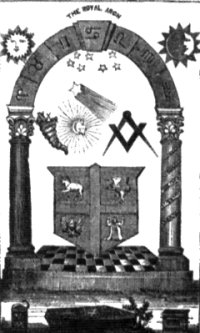
The Lord of the Rings Symbolism - Caverns of Moria

A symbolic arch is supported by 2 pillars, themselves wrapped by climbing vegetation. The arch bears an inscription written in an ancient form of Elvish, saying "The Doors of Durin, Lord of Moria. Speak, friend, and enter." Drawn below the arch are seven stars and a crown, and below these can be found a much larger star (the 'Star of the House of Feanor').

This motif is very similar to the Royal Arch of the Freemasons, who also incorporate seven stars into the space below the arch. Their arch is comprised of 7 houses of the zodiac, whose position in the sky binds the Duat. As such, the seven stars cannot denote the Pleiades star cluster in Taurus, nor the Corona Borealis, or Northern Crown. They are also not suggestive of any stars present in the Duat itself, specifically around Sirius or Orion. The 'Star of the House of Feanor', however, may be analagous with Sirius if we compare the Door of Durin and the Freemasonic Royal Arch. This then gives us a very specific sky location, into which are incorporated a crown and seven stars.

Ciertamente la relacion entre Masoneria y esta Obra de Tolkein no es muy clara pero no podemos dejar de preguntarnos hasta donde puede llegar esta analogia. Se sabe que Tolkein fue un ferviente cristiano pero es bien sabido tambien que muchos Masones profesan alguna religion, dado que es un requisito indispensable para ser Mason Regular (ver: Regularidad Mas:.). Por otra parte, no olvidemos que la Masoneria incorpora dentro de su "mistica" conceptos ansestrales mucho mas antiguos que los mitos, leyendas y religiones ... en otros terminos, de los origenes mismos de la cultura Humana Universal. Por esto mismo podemos encontrar elementos Masonicos en todas partes y en todas las epocas.

Source: http://www.darkstar1.co.uk/ring.html

samedi 4 juillet 2009

LA MASONERÍA SEGÚN LAS ESCRITURAS (1737)

John Tillotson

No muchas son las referencias que se conservan de John Tillotson; Montesquieu lo menciona, así como el caballero de Ramsay en una de sus cartas. Según la Encyclopaedia Britannica, Tillotson (1630-1694) fue deán de la catedral de Saint-Paul en Londres, antes de convertirse en 1691 en arzobispo de Canterbury. En 1675 editó los Principios de la religión natural, de Wilkins. Han quedado bastantes compilaciones de sus sermones, como Cincuenta sermones y la regla de fe (1691), Cuatro sermones referentes a la divinidad y a la encarnación de nuestro bienaventurado salvador (1693) y los Sermones póstumos (1694). Una curiosa recopilación de algunos de ellos, titulada Selección de discursos sobre diversos temas (Select orations on various subjects), impresa a título póstumo en 1737, contiene el texto que presentamos a continuación. Hemos prescindido de ofrecer anotaciones con las referencias bíblicas del texto, pues son demasiado numerosas y apenas aclararían el sentido del documento. On Scripture masonry fue publicado posteriormente en el vol. 74, pp. 89-98, de "Ars Quatuor Coronatorum", Londres, 1961, y Patrick Négrier realizó la traducción francesa (Textes fondateurs de la Tradition maçonnique, 1390-1760, París, Grasset, 1995).


LA MASONERÍA SEGÚN LA ESCRITURA

La divinidad y lo sublime de la masonería tal como aparece en los oráculos sagrados...

Al muy respetable gran maestro de la antigua y honorable sociedad de los masones libres y aceptados, este texto está a él dedicado por el más humilde y obediente servidor de su señor.

El autor.

"Por lo tanto, el Señor, el Ser eterno, dice así: He aquí que yo fundo en Sión una piedra, piedra de fortaleza, piedra angular, escogida, sólidamente cimentada... Haré del derecho un cordel, y de la justicia un nivel" (Is. 28, 16-17).

Habiendo ordenado el edificio del universo en número, peso y medida, y habiendo echado los cimientos del mundo, Dios nuestro muy sabio maestro desplegó el cordel sobre sí, y, como dice Job, lo suspendió en el vacío por (medio) de una misteriosa geometría. Se convirtió así en la imagen sensible de la masonería divina, cuyo eterno plan, cuyo modelo arquetípico, era el objeto de su sabiduría y de su inmenso conocimiento antes de que el mundo fuera. Todo lo hizo gracias a su Hijo, que le era fiel en todos los asuntos de su Casa, y distribuyó a sus obreros y servidores sus tareas y sus pagas. Nada cumplió Dios sin trazado, sin modelo en su decreto oculto, que secretamente guarda al abrigo de las miradas humanas. Pues sus caminos son insondables; sus pasos son ignorados; ¿quién ha comprendido al Espíritu del Señor, o quién ha sido su consejero? Las huellas de su omnipotente providencia subsisten en el jardín de la noche; él mismo habita en una luz inaccesible; pasa a nuestro lado y no le vemos. El masón celestial es un excelente obrero; pero, ¿quién puede dar cuenta de la manera como engendra, de su nombre o del nombre de su Hijo? Él, cuyas primeras actuaciones tuvieron lugar hace tanto tiempo, es invisible como el camino de un águila en el aire, como la aguja de un reloj de sol (a mediodía), o como la revolución silenciosa de la gran rueda del mundo, hasta que él alcance el punto final en que el edificio deberá ser derribado, y su materia dispersada en la región del infinito.

En Heb., 11, 10, Dios es llamado el constructor de la ciudad y de sus fundaciones.

Se le describe ciñéndose él mismo de fuerza, apoyando un compás sobre la superficie del abismo, desplegando los cielos como un pabellón, y afirmando la tierra sobre sus pilares; fijando el número de las estrellas, llamándolas a todas por sus nombres; construyendo las cámaras del sur bajo la bóveda del firmamento; pesando las colinas y las montañas en los platillos de una balanza. Además, dice David, su secreto no es sino para aquellos que le temen; a ellos mostrará su pacto. Si obráis con rectitud, ¿no seréis aceptados? dice Dios. En cada nación, aquel que teme a Dios y obra rectamente es admitido por él. Pero, ¿puede un hombre hacer salir lo limpio de lo que está sucio? Nadie llega al ungido, al constructor de la Casa, si el Padre no le conduce hasta su enviado. Debe ser fiel a la obligación cristiana que ha prometido; debe observar las reglas particulares de la compañía y de la santa comunión, (vivir) en el amor fraterno, separado del mundo y sin conformarse a él. Debe edificarse a sí mismo y edificar a los demás como piedras vivientes, según el mandamiento de su maestro, en todo lo que es digno de elogio, y debe esperar a la Jerusalén de lo alto, cuyos muros son de piedras preciosas, y su pavimento de oro puro.

El Libro de Dios, su voluntad y sus obras son los modelos de la masonería sagrada. Está llena de sublimes misterios, no comunicados a todos. No todos toman parte en el Espíritu de Dios, sólo son hermanos de la santa liga aquellos que han (recibido) la adopción para poder decir Abba, Padre. No tengas miedo, pequeño rebaño, dice el ungido, yo te he escogido y (retirado) del mundo, que no me conoce a mí ni conoce al Padre; pero yo le conozco, y te lo he mostrado. ¿Puede darse a una compañía decreto más elevado y venerable que los emblemas y las imágenes de la comunión, que están colocados tan comprimidos en el volumen del Espíritu santo como las estrellas que centellean alegremente en la bóveda del cielo? Somos llamados el edificio de Dios, su obra, su templo, su morada, a la que ha prometido volver, y ha fijado su domicilio entre nosotros.

Caín no fue aceptado porque abatió a su hermano. Una lección para todos los hombres fieles y benévolos: construyó una ciudad que, al no estar hecha con justicia y virtud, no fue masonería; la moralidad y la piedad son tan esenciales a la ciudad como la arquitectura. Los constructores de Babel fueron dispersados, ya que no poseían ni los signos de la verdadera masonería ni el espíritu que la caracteriza. Nuestros padres antes del diluvio vivían en tiendas, imagen del tabernáculo de la ley y del deseo de nuestro Señor de erigir su tienda con nosotros en el Evangelio, y de conducirnos a su Casa sobre el monte Sión, construida en la roca eterna. La estructura de estas tiendas fue el primer punto exterior de la masonería sagrada en ser inventado. San Pablo, el gran doctor de las naciones, y de esta isla, como insinúa Clemente, era un fabricante de tiendas, tal como leemos en el libro de los Hechos. Dios es el Padre de las luces, el autor de todo bien y de todo don perfecto, y entre otros dones el de la masonería es un talento divino. Moisés dice de Betsael en Ex. 25 que Dios el Dios lo llenó de su Espíritu de sabiduría, de inteligencia, de conocimiento en toda clase de obras. Noé construyó el arca siguiendo las instrucciones del maestro celestial. Moisés hizo todo el exterior del edificio (guardando) la Ley según el modelo (mostrado) en la montaña. Y nosotros asentamos los mejores cimientos, lo más profundamente, en la humildad, ofreciendo nuestra habilidad a Dios y a su gloria; así, el alma construye con la mirada puesta en el cielo, sin (correr el riesgo) de la confusión de una segunda Babel.

¿Qué decir de los pilares de Seth, de la construcción de Babilonia por Nemrod, del templo, del trono, de la flota y de los palacios de Salomón, del complejo de Tamar en el desierto, cuyas asombrosas ruinas todavía subsisten, del templo de Diana en Éfeso, de las estatuas y las imágenes de Nabucodonosor y otros, de la reconstrucción del templo por Ciro y Herodes, de las galerías y los patios del palacio de Assuerus, que (el libro) de Esther describe ornado de columnas de mármol, y dotado de capas de oro y de láminas de alabastro incrustadas de esmeraldas? Todos estos ejemplos de esta sublime ciencia, y otros que (igualmente) se encuentran en los escritos inspirados, son una (fuente) continua de elogios para ella, y citarlos todos se convertiría en una fastidiosa repetición.

Permitidme más bien ilustrar y afinar el proyecto (de esta ciencia) profundizando en los ejemplos que ofrece la Escritura. Señaladas sociedades, formadas según los principios de la sabiduría, de la virtud y de la bondad, que no comunican enteramente su medio de unión, su misterio específico a nadie más que a sus miembros, son y han sido siempre una práctica de todos los tiempos y naciones. Dice Dios: he amado a Jacob, y a Esaú le he odiado, es decir: He aceptado y preferido a uno antes que a otro. De hecho, Dios hizo de la raza de Abraham una sociedad elegida, un pueblo particular que debería ser la regla de la masonería. David comprendió que no había actuado así con ningún otro pueblo, y que los paganos no tenían conocimiento de sus leyes. Estas últimas eran el secreto de la comunidad judía, y estaban asociadas en el culto judío a símbolos y a signos sensibles. Además, nadie, excepto el sumo sacerdote una vez al año, podía penetrar en el Santo de los santos; nadie más que él podía pronunciar el nombre de Dios, estatuir sobre los leprosos, probar las aguas de los celos, responder por los Urîm y los Toumîm, y cumplir otras funciones propias. Éstos son secretos (ignorados) por las naciones. ¿Hubo entre las naciones reyes que poseyeran estas leyes y esta inteligencia? Y la ley, el culto, el arca, eran signos exteriores del modo de unirse.

La primera comunicación de Dios al hombre fue una regla particular, asociada al signo del árbol del conocimiento del bien y del mal. Adán fue expulsado del jardín por haber roto su obligación; el arco iris fue para Noé y su posteridad un signo del nuevo pacto de Dios. La Ley y el Evangelio son pactos que incluyen obligaciones. Los signos (dados) a Abraham eran la circuncisión y la aparición de los mensajeros. Los patriarcas y sus familias formaban una sociedad separada del mundo y agradable a Dios, que poseía los signos de su palabra y un sacrificio no comunicado a los paganos, aunque imitado por ellos. La perfección de la Ley y la obra de santificación fueron hasta entonces en gran medida exactas.

Moisés fue instruido en toda la sabiduría de los egipcios, y en particular en el dominio de la masonería. Él, Jacob y los demás tenían visiones y revelaciones, no acordadas al mundo, y sus prosélitos debían jurar su obligación antes de poder ser aceptados. Buscaban una ciudad permanente no hecha por mano de hombre, aunque el velo sobre el rostro de Moisés probaba que existían misterios que todavía no habían sido revelados. De esta tradición recibieron los paganos sus propia doctrina, reservada sólo a los iniciados. El Credo era antiguamente una palabra, una prueba entre dos cristianos destinada a permitir que se reconocieran en todo lugar. Se le llamó después un símbolo, un signo; otros signos eran las ceremonias exteriores.

Desde la antigüedad hasta este día no se permite a los catecúmenos penetrar enseguida en todo lo que concierne al cristianismo; hay todavía una doctrina oculta en las revelaciones, los profetas y otros libros, y la primera noción de los escritos apocalípticos no estaba, como tampoco está, indiferentemente abierta a todos.

En sus instrucciones, san Pablo establece una distinción entre la leche y el alimento sólido, así como hace una distinción entre los principios y la perfección. El ungido enseñaba mediante parábolas a un pequeño número (de discípulos). La Iglesia del ungido es una sociedad de masonería espiritual, escogida en el mundo, que se comunica con signos exteriores y que asiste a misterios. Ella tiene efectos discernibles con el ojo espiritual, no por el hombre natural. Se le llama casa, construcción; el ungido es la piedra angular, y los apóstoles los cimientos. Subsiste gracias a la edificación (de sus miembros), es el único edificio bien concebido, y éste es todo el trabajo de la vida cristiana que expresa el término de masonería. El ungido tenía muchas cosas que decir a sus discípulos, pero en su tiempo no podían entenderlas, y nosotros todavía miramos a través de un cristal opaco. Hay misterios en la Iglesia del ungido, el maestro masón que negó a los fariseos el signo que otorgó a los apóstoles. Sus instrucciones son excelentes, tanto en el plano de la moral como en el de la inteligencia de esta última. De muchos círculos trazados uno dentro de otro, el último es el más cercano al centro. Igualmente, la grandeza y la vida pública no son pruebas de beatitud, y el último puede ser el mayor en el reino de Dios. La firmeza del símbolo de la escuadra nos enseña que la verdadera sabiduría no debe ser quebrantada; y el nivel (nos enseña) que el corazón sigue siempre sus inclinaciones sin alcanzar un enderezamiento, que jamás es igual, y por ello no encontramos aquí abajo ni reposo completo ni satisfacción.

Una regla que intenta ser justa nos prohíbe abandonar nuestra razón por nuestras pasiones, y (nos obliga) a conservar la regulación (ejercida) por el juicio. El corte de las rocas con el cincel nos enseña que el arte y la industria superarán las dificultades. Un ingenio hidráulico nos enseña que el pecado nos obliga a compensar nuestra labor con nuestras lágrimas. Una rueda que no mueve a ninguna otra a menos de ser ella misma movida nos muestra que nuestro propio corazón debería estar preparado ante los sentimientos que queremos inspirar, y que deberíamos amar a Dios para poder ser amados. Una pirámide nos muestra que deberíamos, aunque aparentemente fijados en el suelo, aspirar al cielo. Una columna nos muestra que los inferiores son el soporte de los superiores, un templo que estamos dedicados a la virtud y al honor. Un compás que traza un círculo de un solo trazo muestra que una acción puede tener consecuencias sin fin, tanto en el bien como en el mal. Y el hecho de que una columna invertida parezca más grande en su parte inferior nos enseña que el Espíritu (también reside) en la adversidad y en la muerte, que las aflicciones deberían animarnos, y que la pérdida de la vida (debería) recordarnos una gozosa resurrección.

Hay un principio vital emanado de Dios en esas piedras y esos minerales que son la materia primera de la masonería. Dios es todo en todos. Pero así como los ojos de los apóstoles estaban constreñidos a no poder reconocer a nuestro Señor en su cuerpo espiritual, sólo un pequeño número es capaz de discernir el fuego interior de la tierra cuando madura los frutos de este elemento, así como los minerales utilizados en la construcción y en la vida cotidiana, y que exhala constantemente un vapor que san Juan comparaba con la hoguera y el humo del infierno. Oremos para que la voluntad de Dios pueda realizarse sobre la tierra como en el cielo, que la energía y las potencias de la naturaleza puedan subsistir gracias a su presencia, con respecto a la cual David declara que nada podría disimularla. La sal de la tierra nutre a las piedras, como el maná alimentó a los israelitas en el desierto. De ahí viene que los adeptos nos enseñen que esta sal es llamada con el nombre de Dios, ‘eheyeh, Yo soy, que es el autor y la vida de esta sal, así como ésta lo es de otros seres. San Juan, cuya Revelación es el programa de la masonería espiritual, conocía la piedra blanca, y vio al Hijo de Dios ceñir alrededor de su pecho un cinturón de oro.

El número 3 aparece de manera señalada en el Libro de Dios para ilustrar la Trinidad: el Padre, el Hijo y el Espíritu Santo; (está) el cuerpo, el alma y el espíritu; el hebreo, el griego y el latín puestos encima de la cruz; Santo, santo, santo, dicen los serafines; (está) el día en que (Jesús) trabaja, aquel en que descansa y aquel en que volverá a trabajar; Job, Daniel y Noé, los tres profetas que se habrían salvado juntos; Eliphaz, Sophar y Bildad; Ananías, Azarías y Misaël, Shem, Ham y Japhet. También los tres hijos de Adán más conocidos, que eran Abel, Caín y Seth; están además los de Terah, de quienes hemos recibido las promesas, Haran, Nahor y Abram. En fin, tres ángeles aparecieron; tres joyas (adornadas) de piedras preciosas se hallaban sobre el pecho de Aarón; tres letras componen la raíz de cada palabra hebrea; tres veces al año los judíos debían acercarse a Jerusalén; tres días durante los cuales Jonás estuvo en la ballena, y el ungido en la tumba. Hay tres Juanes: el Bautista, el Evangelista, y Marcos, sin contar con que hay otros Marcos distintos a éste.

Por su parte, el número 7 era el del (día del) sabbat, cuando el Creador descansó de sus obras; 7 es el número del jubileo, del año de gracia; los siete ojos de Dios son mencionados, así como los siete brazos del candelabro del templo; está el libro de los siete sellos, y siete ángeles, los siete meses (de la construcción) del tabernáculo. El templo fue construido en siete años. La sabiduría séptuple y la providencia de Dios se muestran en sus acciones. La Pascua se celebra siete veces siete días antes (del don de) la Ley. Éste es un ejemplo de la presencia de los números más perfectos en la Biblia.

Jeremías recibió la orden de construir y de demoler. Fue para disuadir la impiedad, (el signo) del riesgo de que se construya para ver a otro habitar, o de que el Señor abandone el edificio a la desolación. Las piedras del muro gritaron contra la opresión y la injusticia. Es un estímulo al deber, y (el signo) de que la palabra de Dios es capaz de construirnos en derechura, y también (el signo) de que probará la obra de cada hombre mediante el fuego, para demostrar que no se puede poner cimiento distinto de aquel del cual él mismo es el fundamento, el ungido salvador. Es un aliento a la caridad, a que seamos edificados juntos para (convertirnos) en una morada de Dios en el Espíritu, y a que mantengamos firme la profesión de nuestra fe hasta que la piedra rechazada por los constructores se haya convertido en cabeza de ángulo. Es un estimulante para la obediencia (saber) que aquel que ha construido todas las cosas es Dios.

La palabra masón, que es una de las últimas palabras exotéricas (el nombre trascendente, el nombre sagrado, es menos conocido y no puede ser verdaderamente pronunciado más que por los iluminados) viene del francés maison, que significa casa. Somos la morada del ungido, dice el apóstol en Heb. 3, 6. El Señor construyó Jerusalén, dice David en el salmo 147, 2. Ha trazado un camino hacia ella. El ungido es el camino en Jn. 14, 6. Abre la puerta que introduce; el ungido es la puerta en Mt. 7, 13; y nos regala en su morada con su cuerpo y su sangre los frutos de la rectitud. No os enorgullezcáis, dice el ungido, de tener a Abram por Padre, pues Dios es capaz de hacer brotar hijos de Abram de estas piedras. El ungido es llamado por el apóstol el peñasco espiritual, y la conversión de nuestros corazones de piedra en corazones de carne es (el efecto) de su redención, que nos aporta para nuestro arrepentimiento. (Dice en) Jn. 14, 2: En la casa de mi Padre hay muchas moradas. Morada viene de maneo, morar, que sugiere un objetivo a alcanzar cuando se es miembro de la logia celestial. Muchas iglesias y condiciones particulares son etapas en el camino que conduce a la casa que ningún terremoto puede destruir y que ninguna tempestad puede sumergir. Lo que era de su Padre también era suyo. Todo lo que posee el Padre me pertenece, dice el ungido; y es como si nuestros bienes también fueran suyos. En la esperanza de ello, los elegidos, aquellos que son aceptados, siempre se han lamentado: ¡Desgracia a mí, por residir en Mechek y habitar entre las tiendas de Kedar!

Por su parte, una temible representación de la logia celestial (Gen. 28, 16) arrancó a Jacob esta exclamación: Esto no es sino una casa de Dios, y es la puerta del cielo. ¡Álzate! dijo Dios, he puesto ante ti una puerta abierta que nadie puede cerrar (Ap. 3, 8). La Iglesia es la Casa de Dios, y está en todas partes. Job la encontró en la tierra, Ezequías en su lecho de muerte, Jeremías en su celda, Jonás en el mar, Daniel en la fosa, los tres niños en la hoguera ardiente, Pedro y Pablo en la prisión, el ladrón en la cruz. El cuerpo, llamado templo del Espíritu Santo, debe ser reconstruido en la resurrección en vistas a la adoración durante el reposo eterno. La Iglesia, la Casa de Dios, era antaño llamada, dice el Doctor Donne, el famoso deán de Saint-Paul, oratorio (porque se) pedían a la providencia divina las cosas necesarias. Pues vanos son nuestros esfuerzos sin su asistencia. A menos que el Señor construya la Casa, los obreros trabajarán en vano, dice David.

Y Mt. 21, 44: Aquel que caiga sobre esta piedra fracasará, y aquel sobre el cual caiga, ella le triturará. Aquel que ofenda al ungido, la piedra sobre la que se apoyó Jacob, será confundido. Y si en el juicio ella cae sobre el delincuente, su peso le aplastará más fuertemente a como la piedra de David (aplastó) la frente de Goliath, y le destruirá incluso más que la tumba.

Así como los lugares santos del templo de Diana fueron preservados, así nosotros somos un modelo de lo divino. Aunque los cielos de los cielos no puedan contenerle, se aloja en un corazón contrito. David rezó para tener un frenillo sobre el umbral de sus labios. El hombre interior es el lugar santo, el coro, y las bellas cualidades son sus tesoros y sus ornamentos. El santo de los santos es la conciencia arrepentida, en la que la fe y la caridad son dos querubines que recubren la misericordia de las sillas. Aquí está el oráculo divino, el Dios de quien dan testimonio nuestros espíritus que son sus hijos. Sólo el gran sacerdote, el salvador, puede entrar aquí y contentarnos.

Aquí se encuentra el arca de la Ley, el maná del perdón y de la consolación, el candelabro dorado del entendimiento iluminado, los panes de la rememoración, el velo de la rectitud, con el que el salvador oculta nuestros defectos; las columnas, los utensilios, las decoraciones, son la verdad y la justicia, ornamentos de un espíritu bien dispuesto, que son de gran valor ante los ojos de Dios.

Las elevaciones de este género a partir de la Escritura son infinitas. No hay un aspecto de la masonería, desde el porche hasta las murallas, del umbral y del dintel asperjado contra el mal mensajero, hasta la cámara elevada donde los apóstoles se reúnen; no hay un instrumento, desde el hacha que Eliseo ordenó recuperar hasta la plomada del profeta, ni una figura, desde la línea hasta el círculo de los cielos, que no estén santificados por una mención expresada en la lengua de Canaan. Y la referencia a la totalidad de este sistema, en cualquier sociedad, está autorizada por los muchos paralelos (que se encuentran) en la tribuna sagrada de la Escritura.

Pero en el momento de la consumación de todas las cosas, la ciudad de nuestro Dios tiene doce puertas para que los elegidos penetren por el este, por el oeste, por el norte y por el sur, a fin de residir en el reino de Dios. La puerta estrecha es el pasaje a lo que se llama belleza, por el cual entraremos en el corazón (al son de) la alabanza.

Es así que David prefería ser guardián del umbral antes que habitar en las tiendas de la perversidad. La condición para poder pasar esta puerta es creer en el salvador; los dos (senderos ascendentes) laterales son la paciencia y la inocencia; el techo es la caridad. Permaneced firmes en la fe, dice san Pablo. De aquí viene que la Iglesia tienda a que la fe sea llamada pilar y fundamento de la verdad. La entrada de este jardín está guardada por la espada flamígera de la justicia divina. El muro (del recinto) no puede ser medido más que por la caña del ángel. Es un secreto para la razón humana. Por siempre está en la cumbre de las colinas eternas. Aquellos que las frecuentan son justos y perfectos.

Ser, en virtud de la obligación cristiana, miembros libres de esta ciudad consiste, como Agustín decía de Roma, en exaltar la arcilla como si fuera mármol, y en revestirnos de nuestra Casa de lo alto, que en los cielos es eterna.

Memphis-Misraim

Los Masones de Memphis-Misraim conciben la Masonería como una Orden situada fuera del espacio y del tiempo. Que une a todos los Iniciados de todos los países y de todos los tiempos, Hermanos de toda condición y origen, de todas las creencias y formas de pensar, que conjugan sus esfuerzos en la construcción del Templo Ideal de la Verdad, de la Justicia, y de la Concordia.

Ellos consideran, que mas que una institución, la Masonería es un método tradicional de acceso al conocimiento, y a través de el, a la libertad. Que la búsqueda fundamental es aquella de la Verdad la cual no puede ser cristiana, ni budista, ni islámica, y ni siquiera masónica...., puesto que ella no es sino la Verdad.

Ellos rechazan la estrechez del punto de vista petrificado que afecta una cierta cultura occidental, y que sitúa sus orígenes en las pilas bautismales de la era cristiana, con un desprecio deliberado por sus fuentes griegas, egipcias, medio orientales para no hablar de las nórdicas y del lejano oriente.

Ellos consideran que la búsqueda de la armonía en el conocimiento, en las conductas rituales, en el simbolismo, y en las reglas de vida, conduce a un conocimiento mas profundo de las fuentes iniciáticas.

Características de la Orden del Rito Antiguo y Primitivo de Memphis-Misraim
La Orden Masónica Universal del Rito Antiguo y Primitivo de Memphis-Misraim tiene como características las de ser: Tradicionalista, Simbólica, Iniciática, Esotérica, Deísta, y de Masonería Egipcia.

Con estos calificativos, los Masones del Rito quieren recalcar la solidez de su nexo con la “Tradición Masónica”, vehículo de la Tradición Primordial, fuente común, patrimonio constituido por los descubrimientos resultado de la multimilenaria búsqueda del conocimiento por parte de la humanidad.

La tradición masónica no es mas que la expresión del “Código inmutable” de valores esenciales de todas las civilizaciones pasadas y futuras. Este código se fundamenta en el respeto de los Derechos y Dignidad del ser humano, y en la independencia de su espíritu e integridad de su cuerpo. La negación de los valores que forjan nuestra ética, significaría un retroceso seguro, cualquiera que sea la magnitud del progreso tecnológico o científico.

En medio de la confusión que caracteriza nuestra época, se ha alterado y desnaturalizado el término de Tradición, atribuyéndole una connotación unas veces desueta, y otras conservadora e “integrista”. Debemos cuidarnos de la distorsión del lenguaje que frecuentemente deforman las ideas que en realidad le corresponden. Nuestra referencia a la Tradición no debe ser confundida con una “posición esterilizarte” o con un “conserva ismo obtuso”. Romper con la Tradición, significa romper con la Sabiduría y los Principios Universales de la Consciencia Humana.

Simbólica e Iniciática
La Masonería Operativa nos llega de las épocas más remotas, que va desde los constructores de las pirámides hasta los de las catedrales pasando por las corporaciones tirias y judaicas, los colegios romanos y las cofradías medioevales. Ella fue el vehículo de una técnica iniciática antes de dar origen a la Masonería especulativa. Ella crea un lenguaje simbólico en el cual las herramientas que se les atribuyen a los grados de Aprendiz, Compañero y Maestro son un ejemplo. Esto con el fin de transformar la Piedra bruta ( el profano ) en la Piedra tallada que toma su lugar en el edificio del Templo Universal. La enseñanza iniciática se apoya en la voluntad y el esfuerzo que cada quien realiza para tallar su piedra. El símbolo, es un vehículo universal que permite sobrepasar los obstáculos de las lenguas y de su confusión, y que tiene por función de sugerir, siendo como es, un sistema abierto para un pensamiento libre.

Esotérica
En las Constituciones del Rito de Memphis-Misraim, podemos leer esta proclama “Tu tienes dos orejas para escuchar el mismo sonido, Dos ojos para percibir el mismo aspecto, Dos manos para ejecutar la misma acción”. Igualmente “La ciencia masónica es esotérica y exotérica -El esoterismo constituye el Pensamiento -El Exoterismo es la acción que le sigue.

Sin embargo, todavía hoy, el concepto de esoterismo es frecuentemente ignorado. Nos parece por eso necesaria la definición de lo que significa “esotérico” que viene del griego “esotericon”-“reservado a los adeptos”, y que es el calificativo utilizado por los filósofos de las antiguas escuelas para indicar que ciertas materias eran necesariamente incomprensibles o difícilmente interpretables por personas no iniciadas.

Deísta
Según la definición de este término, la Orden de Memphis-Misraim no se refiere a ninguna Divinidad Revelada. Si ella trabaja “A La Gloria del Sublime Arquitecto de Todos los Mundos”, ella profesa igualmente la fe en el progreso humano y postula la existencia probable de una inteligencia que actúa en el Universo. Es adogmática y practica la tolerancia mas grande, ya que corresponde a cada Mason el forjar sus propias convicciones, conservarlas, o cambiarlas. Cada Mason es libre de sus creencias y de sus opiniones, a condición de no tratar de imponerlas a los demás y de no pertenecer a tendencias de tipo integrista o intolerante.

La Orden Masónica de Memphis-Misraim considera al Sublime Arquitecto de Todos los Mundos de “Principio Ordenador que puede ser evocado con cien nombres diferentes” y que “la razón humana es tan incapaz de definir como de negar”

Egipcia
Nuestro Ritual se deriva del Rito de Memphis. Este contiene restos de los antiguos Misterios Egipcios celebrados antiguamente en los Templos de Memphis y hallados por Gerard de Nerval en el seno de Masonería Drusa de Líbano. Esto condujo a los masones que acompañaban a Bonaparte en su misión en Egipto, a rechazar la autoridad masónica de la Gran Logia Unida de Inglaterra y a fundar un nuevo Rito.

El Antiguo y Primitivo Rito de Memphis-Misraim, le permite ser un Rito mas espiritual y mágico, ya que su finalidad no es alimentar el "ego falso" a través de conocimiento intelectual al por mayor, ó por incluir miembros pudientes, políticos y empresarios para prestancia de "roces sociales", sino para restaurar el alma humana y convertirla en un alma espiritual en cada Iniciado.

Source: Masoneria para Todos

LEGEND OF YORK

"This craft came into England, as I tell you, in the time of good king Athelsan's reign; he made then both hall, and also bower and lofty temples of great honor, to take his recreation in both day and night, and to worship his God with all his might. This good lord loved this craft full well, and purposed to strengthen it in every part on account of various defects that he had discovered in the craft. He sent about into all the land, after all the masons of the craft, to come straight to him, to amend all these defects by good counsel, if it might so happen, He then permitted an assembly to be made of divers lords in their ranks, dukes, earls, and barons, also knights, squires and many more, and the great burgesses of that city, they were all there in their degree; these were there, each one in every way to make laws for the state of these nations. There they sought by their wisdom bow they might govern it; there they found out fifteen articles, and there they made fifteen points."----Regius Manuscript, circa 1390----Regius Manuscript, circa 1390

THE YORK RITE

The York Rite takes its name from the Ancient English city of York, around whose minster, or cathedral, cluster many Masonic traditions. Here , these traditions tell us, Athelstan, who reigned more than a thousand years ago and who was the first king of all England, granted the first charter to the Masonic guilds. Here, in 1705, a Grand Lodge in London, to whose constitution the Grand Lodge of England later appealed as the true source of authentic Freemasonry. Though early disappearing from the Masonic scene, this Grand Lodge left an indelible impression upon the institution, and its name --- York --- will survive as long as Freemasonry continues.

source: yrscna.org

mardi 23 juin 2009

The Ingredients of a Masonic Degree

There are a lot of places to learn about Masonic ritual. One can experience it first hand (which is the recommended course, in my opinion), or read an exposure of the ritual either in print or on the Internet. Sometimes people are curious what is involved, but don't want to read something so shady to find out. Well, this is the right place! Here's an overview of what a Masonic Degree entails, without spoiling the experience or giving away any secrets. I will give an outline first, then details.
  1. Prologue
  2. Preparation
  3. Reception
  4. Circumambulation and Scripture Reading
  5. Approaching the Altar
  6. Obligation
  7. Instruction
  8. Apron
  9. Working Tools
  10. Return and Revestment

  11. Drama
  12. Lecture
  13. Charge
This list of events constitutes the degree proper. There are also opening and closing ceremonies that bookend the degree, with the potential for Lodge business to be conducted either after the opening ceremonies or before the closing ceremonies. Now for the details:

1. Prologue

In the Three Symbolic Degrees, the Prologue is found in the Entered Apprentice Degree and consists of a series of questions propounded to the candidate who has been patiently waiting during the opening ceremonies. These questions establish the man's eligibility to proceed with the degree. In York Rite's Chapter and Council the Prologue of a Degree sometimes takes on a dramatic character of its own, serving a purpose similar to "Act I" of a three-act play.

2. Preparation

The candidate is changed into certain symbolic clothing and/or given some basic instructions. He is then led to the door of the Lodge where he knocks to gain admission.

3. Reception

After some questions at the door to establish the purpose of the alarm, and the qualifications of the candidate, he is admitted and "received" into the Lodge by a symbolic act accompanied by a short explanation of this symbolism, which varies in each degree.

4. Circumambulation and Scripture Reading

Depending on the degree, and particularly in the Entered Apprentice Degree, an additional prayer may be offered at this point (in addition to the one at opening.) Next, the candidate is led clockwise around the Lodge a certain number of times, while a passage of Scripture is recited appropriate to the degree being conferred.

5. Approaching the Altar

After more questions with the Junior Warden, Senior Warden, and Worshipful Master, the candidate is conducted to the altar where he will receive his obligation.

6. Obligation

This is the heart of the degree. It is what makes the man a Mason. The candidate is informed that his Masonic obligation can never conflict with his duty to God, to his country, his neighbor or himself. He is also given the opportunity to "back out" at this point, if unwilling to proceed. Once he proceeds, he takes the full obligation, which varies in each degree.

7. Instruction

Now that he is obligated, the Brother learns the secrets pertaining to the degree to which he has just attained. These secrets are much discussed elsewhere, and I can only say with propriety that they typically consist of a password, a grip ("secret handshake") and a couple of signs. His knowledge of these signs is then demonstrated to the Junior Warden, Senior Warden, and Worshipful Master.

8. Apron

The candidate is given an Apron and/or taught how to wear his existing one, according to his particular degree. A short history or explanation of the symbolism of the Apron is given.

9. Working Tools

Now that he is wearing his Apron properly, the Brother is ready to be presented with the Working Tools of the degree. These are regular builder's tools with which the world is already acquainted, but they are presented with an explanation of their moral symbolism. For example, the plumb-line teaches us to walk uprightly before God and man.

10. Return and Revestment

The Brother is conducted out of the Lodge, where he changes back into his ordinary clothing (continuing to wear the Apron, however, as taught in the degree) and he is returned to the Lodge room.

11. Drama

The drama varies greatly with each degree. For the Entered Apprentice, it is nothing more than a short admonition from the Master (we're talking two sentences.) For the Fellow-craft the Drama is integrated with the Lecture itself (which will be explained next). For the Master Mason Degree, and many of the York Rite Degrees, it is an elaborate and beautiful performance in which the Candidate takes an active role (with his conductor guiding him and sometimes speaking on his behalf.) The drama section of the degree is often done in costume with great effect. If the obligation (although short in duration) is the main course of the Degree, the drama is like a fine dessert, without which the meal would be incomplete.

12. Lecture

The lecture recounts the ceremonies of the degree which have been performed, endeavoring to explain some of their meaning and inspiring contemplation upon the rites and symbols by the candidate. It often contains a commentary of philosophical and moral value, along with additional historic material pertaining to the degree. These Lectures can range from a half hour to an hour long and are, today, memorized word-for-word (quite an impressive feat!) A portion of this lecture includes a Question and Answer examination about what the candidate has passed through and a test of his knowledge of the passwords, grips, and so forth. This portion of the lecture becomes the Candidate's duty to learn and present before the Lodge before he may be advanced to the next degree.

13. Charge

The charge is a short statement given to the Mason outlining the particular type of moral behavior and refinements of character expected by a Brother of this degree. (A historical side note: After reading The New Masonic Trestle-board, a product of the National Masonic Convention of 1843 held in Baltimore, I believe all the charges used in the USA were written wholly by brother Thomas Smith Webb, which accounts for the slightly different ring to their vocabulary as compared to the rest of the degree work and lectures.)

I hope this post has been enjoyable. I'm also curious how accurately it reflects the order of the degree work as it is conducted by other Masons around the world.


Source: http://blog.kingsolomonslodge.org/

English Rite Degrees


1. Entered Apprentice
2. Fellow Craft

3. Master Mason


Capitular Degrees


Mark Master -
The work on the temple continues. Amplifying the Fellowcraft Degree, we are taught that the knowledge we received there can be employed most usefully and judiciously for our honor and the profit of others. A beautiful lesson is exemplified, inculcating the truth that although we are often misunderstood, underrated and traduced, there is ONE who will make the rejected stone the head of the corner.

Past Master -
This Degree begins the preparation for the Royal Arch, which we are told was removed from the Symbolic Degrees of which it once was part, to reserve it for the more earnest seeker of more Light in Masonry. Originally only Past Masters of Lodges were admitted to the sublime secrets of the Royal Arch. This meant that very few could receive them. The Degree of Past Master (Virtual) teaches the candidate that he must first learn to obey before he can rule, and to govern himself before he can govern others.

Most Excellent Master -
This is a significant Degree in Ancient Craft Masonry. King Solomon's Temple, which was begun so auspiciously and halted so dramatically in the Third Degree, is completed amid much rejoicing and great splendor. The labors of the Craft are given the blessing of the Lord, who descended as fire from heaven. King Solomon, in his gratitude, received and acknowledged them Most Excellent Masters, empowered to travel and receive Master's Wages, and charged them with the responsibility of sharing their Masonic Light and Knowledge with those less informed.

Royal Ark Mariner -
This degree is set in the time of Noah and his sons, and relates events prior to, during, and after the Flood. The degree is interesting because much of it is set in unrhymed meter, and because axes are used in place of gavels and undressed aprons for lambskin ones. The candidate receives the customary obligation, signs, words and a lecture. The lesson taught is one of trusting in God's goodness and mercy. Earlier in AMD history, separate Lodges of Royal Ark Mariners were attached, or "moored", to a particular Council, but this is no longer practiced.

crypticrite_small.gif (3137 bytes)
Cryptic Rite degrees
[ based on the building of King Solomon's Temple ]


Royal Master -
This Degree takes us backward in time to a day prior to the death of the builder, who is again the central character. He imparts sublime teachings of a useful labor on earth to the candidate and gives him instruction as to the preservation of our valuable secrets. This is one of the most beautiful Degrees in all Masonry. Its lessons are so impressive that they are seldom forgotten. It is especially illustrative of the third and seventh Degrees.

Select Master -
Historically, this Degree occurs also prior to the third Degree, and deals with incidents that occurred at the building of the first Temple. It is closely connected with the Royal Arch Degree and affords the explanation needed for its perfect understanding. It is highly dramatic.

Super Excellent Master -
This Degree refers to circumstances and incidents during the siege of Jerusalem and the final destruction of the Temple. The work is dramatic and most impressive. This work completes the Circle of Perfection of Ancient Craft Masonry, but to the follower of Christ there is a definite need and desire for the application of these impressive lessons and beautiful ceremonies to his way of life. To fulfill this need we have the Commandery -- Knights Templar.

ram_small.gif (2781 bytes)
Holy Royal Arch

Royal Arch Mason
-
In this Degree we find the completion of the Master's Degree and the Recovery of the Word. After the death of King Solomon, his magnificent Temple was destroyed and the Israelites carried away as captives to Babylon, where they lived for about 70 years. Here, many acquired considerable wealth and attained high rank and influence in the Chaldean government. However, when liberated by King Cyrus, many of them returned to Jerusalem and began rebuilding the Temple. While this work was going on and the rubbish of the ruins of the first Temple was being cleared away, many interesting and valuable discoveries were made, chief of which was the recovery of the Lost Word. With the recover of that which was lost, it would seem to the novitiate that his search for Light was ended. However, in order that he might better acquire the lessons, a seemingly inverse movement of the Degrees, historically, is set up


Holy Royal Arch Knight Templar Priest


Red Cross of Constantine

___________________________________

Masonry's Most Secret Degree

I find it interesting that Masonry's best kept secret might be the "Royal Arch Widow's Degree", a humorous side-degree unofficially worked by some Royal Arch Chapters.

A couple of well-crafted Google searches can land the full text of nearly any Masonic degree, exposed somewhere online, perhaps not in the format worked today or in a jurisdiction near you, but usually at least something shows up. This is not the case for the Royal Arch Widow's Degree. I don't know if this is good, bad, or weird. Of all the secrets Masonry has, this one seems the least apt to be a real secret, and the Brethren who perform it aren't under any obligation to keep it so. Maybe its insignificance keeps it from being of any interest to the Anti-Masonic crowd? But, this really all doesn't matter... I guess what really intrigues me about this is that the Internet doesn't have everything on it. We tend to think we have all information at our fingertips, but it really isn't the case. Maybe there are a whole slew of other degrees, perhaps authentic, serious ones, that are not available at all online? So, I guess the mysteries offered by the world's various fraternal orders cannot be fully penetrated by the Internet after all, and the only way to gain what they have to offer is to be initiated.

Mark Master Mason ou Homme de Marque

« Au vainqueur je donnerai de la manne cachée, je lui donnerai une pierre blanche, et, gravé sur la pierre, un nom nouveau que personne ne connaît sinon qui le reçoit. »

Apo. 2, v.17

lapidem quem reprobaverunt aedificantes hic factus est in caput anguli

psaume 117:22

On dit la Maçonnerie de Marque très ancienne, beaucoup plus, même que le Rite de Style Emulation sur lequel elle vient se greffer. Un procès-verbal de Tenue de Maîtres Maçons de Marque daté de 1642 repose aux archives de la Loge de Kilwinning. Cependant, il convient de rester prudent car ce texte tout autant que la plupart des anciens documents qui sont parvenus jusqu'à nos jours, parlent de marques de compagnons, de signes d'ouvriers comparables à des signatures, mais aucun ne donne quelque information que ce soit sur ce qui pourrait être plus convenu de nommer "Grade de la Pierre de Faîte". Alors la question reste de savoir si le thésaurus qui s'y rattache est un rajout à la pratique des deux premiers degrés ou bien un parcours maçonnique dans sa complétude.


Cette Maçonnerie, dont la seule origine certaine est qu'elle vient des Amériques et particulièrement de l'actuelle province du Québec, s'est répandue en Irlande et en Angleterre, pays dans lequel elle s'est constituée en Grande Loge de Marque en 1856, laquelle est toujours en activité aujourd'hui.


Ce degré est une continuation de l'ancien grade opératif de Compagnon (à l'origine, le grade de Compagnon était le dernier degré initiatique, l'appellation de Maître étant réservée uniquement au Maître ou Vénérable qui présidait la Loge). Son enseignement met l'accent sur la fameuse « pierre angulaire » rejetée par les bâtisseurs et qui est devenue la pierre d'angle maîtresse de l'œuvre. Sur cette pierre qui n'est autre que la clé de voûte de l'édifice, le Mark Mason inscrit sa « marque ».


La cérémonie de réception d'un nouveau Maître maçon au sein d'une Loge de Maîtres Maçons de Marque présente aujourd'hui, la particularité de regrouper deux anciens rites, celui d'Homme de Marque (Mark Man) et celui de Maître de Marque (Mark Master Mason). Les rituels anciens ont souvent été remaniés, mais ils conservent encore un certain nombres d'éléments que l'on pourrait qualifier d'explicatif quant au déroulement particulier des cérémonies de Loges bleues de différents rites.


De nos jours, lorsque les membres d'une loge de marque se sont assurés que leur candidat pour le Degré De marque a atteint le statut de Maître Maçon d'une Loge bleue, on lui donnera connaissance de l'antiquité de la pratique qu'il va être amené à connaître. La coutume ancienne veut qu'un Compagnon tailleur de pierre soit invité à choisir une Marque qui lui sera propre et qu'il gardera toujours come sa signature personnelle. Cette marque devra être différente de toutes autres employées par les membres de la Loge, de telle manière que son travail puisse être reconnu comme siens par les officiers que l'on nomme Inspecteurs. On l'informera aussi que c'est cette marque qu'il devra présenter au guichet tenu par le Premier Surveillant, à l'Ouest de la Loge, là où il percevra son salaire d'Homme de Marque

S'il constate qu'il n'a reçu aucune marque distinctive de sa Loge bleue comme c'est, bien entendu, le cas pour les Loges Ecossaise, il se rendra auprès du Gardien du Registre de Marque et déposera sa marque distinctive dans le Livre. Elle sera alors présentée au Vénérable Maître afin de recevoir son approbation. Durant les cérémonies modernes de la Marque, cette partie de la réception qui confère le statut d'Homme de Marque est souvent exécutée trop promptement et nous oublions tout aussi souvent de quelle manière le Vénérable Maître accueille le nouveau Compagnon : « J'admire le savoir faire dont vous faites preuve à l'exécution de votre travail et c'est la raison pour laquelle je vous nomme Homme de Marque et vous confie la marque qui confirmera votre statut et vous permettra de recevoir votre salaire. » Cette distinction confère à celui qui est déjà Maître Maçon, la reconnaissance de ses qualités. Elle ne lui permet pas de disposer de poste ou de fonction particulière au sein de la Loge Bleue, néanmoins, à l'origine, à l'époque où les distinctions de métier pouvaient être regardées comme des avancement, le fait d'être reconnu et de disposer d'une marque, offrait un avantage certain en matière de rémunération. Cette distinction, aujourd'hui ne représente pas plus que le fait de recevoir un nouveau maître dans un cadre intermédiaire, une nouvelle étape maçonnique, c'est la raison pour laquelle le rituel relatif à l'accession au grade d'Homme de Marque s'effectue, aujourd'hui, dans la même cérémonie que l'élévation à l'honorable degré de Maître de Marque. Ce mode de réception est l'héritage de l'ancienne forme de la maçonnerie de la Marque et le fait de garder intacte une partie de la rituélie concernant l'élévation au gage tout autant que la gestuelle du guichet se présente comme une explication des termes de la clôture des travaux des Loge Bleues. A savoir que les Frères reçoivent leur salaire au pied de la Colonne du midi et qu'ils en retirent profit et joie. On peut, d'ailleurs constater l'illustration de ces propos sur les anciens tableaux de Loge de Maître Maçons de Marque sur lesquels ont peut observer l'illustration des deux degré composant la marque, à savoir le guichet où l'Homme de Marque vient percevoir son salaire et les trois pierres taillées du Maître de marque avec la référence aux outils correspondants et aux mots de passe.


Un tailleur de pierre qui recevait sa marque personnelle, se voyait qualifié d'artisan, voire de Maître ou de Compagnon (ce qui était le plus fréquent) de métier. Le Maçon de cette catégorie, c'est-à-dire, doté d'une certaine indépendance, n'appartenait plus, en tant que tel à la Loge mais devenait un maçon libre qui voyageait de Loge en Loge. On reconnaît là, encore une fois une tradition des maçons de Loges bleues dans lesquelles les Compagnons doivent voyager afin de parfaire leurs connaissances en l'art de maçonnerie. Cette étape pratique vers l'indépendance du maçon, sa qualité de « maçon libre » est probablement l'une des raisons qui présida à sa conservation durant les années 1750, à l'époque de la refondation du degré de Mark Master par Thomas Dunkerley, comme d'un usage très ancien. Cette pratique de l'Homme de Marque est assez déterminante dans l'histoire de la franc-maçonnerie dans la mesure où ce degré fait directement référence au grade de Compagnon. Cette référence directe et son adjonction à un nouveau degré de Maître permet de comprendre pourquoi il ne s'agit pas d'un « Haut Grade » en tant que tel, mais bien d'une voie parallèle, un Side Degree dont les enseignements viendraient compléter celui des Loges Bleues. En donnant une marque propre à chaque compagnon, on finissait son parcours et l'introduisait dans une fonction complémentaire, une progression de métier qui confirmait son savoir faire sans pour autant lui conférer le grade de Maître. Ils pouvaient néanmoins signer leur ouvrage et c'est pourquoi on ne les nommait plus Compagnons, mais « Compagnons marqués » ou Hommes de Marque.


Les Loges bleues terminent leurs travaux sur la remise du salaire et cet instant particulier, en référence à l'Apocalypse de Saint jean, détermine de qui doit le recevoir et de qui doit le donner car il est dit :« je lui donnerai une pierre blanche, et, gravé sur la pierre, un nom nouveau que personne ne connaît sinon qui le reçoit. », ainsi, le Vénérable demandera au Premier Surveillant de s'assurer que les travaux sont fermés et chacun passera devant la Colonne, les Apprentis, ne reçoivent pas de Salaire, les Maître les donne. « J'ai constaté, Vénérable Maître, que les Compagnons se déclarent satisfaits. » Néanmoins, comme je l'ai dit, cette qualification donnait à l'homme de marque un statut particulier assez différent de celui de simple compagnon. En effet, l'élévation comportait le récit d'un mythe propre au grade. Le matin du jour où fut posée la pierre de fondation du Temple de Jérusalem, sous la présidence du Roi Salomon, une pierre précieuse tomba accidentellement de la couronne royale. Elle fut trouvée et ramassée par le Premier Maître de l'Ordre des Hommes de la Marque qui la rendit au roi qui la replaça sur son front. Cette pierre précieuse portait le nom Imprononçable que l'on suppose ainsi avoir été marqué sur la couronne royale, comme il avait déjà été gravé sur la mitre du Grand Prêtre Aaron

« Tu feras une fleur d'or pur et tu y graveras en intaille, comme un sceau : Consacré à Jehovah ; » Exode, 28 ; 36 »

Ensuite, lors de la construction du Temple de Salomon, une pierre d'angle eut été aillée par un apprenti très doué, mais elle fut dérobée par des Compagnons jaloux.

On demande au candidat de la rechercher il la retrouve et il constate qu'elle porte, gravé, le nom Imprononçable. Nous ne sommes pas encore dans le développement d'une symbolique d'équilibre de construction mais, on voit bien, ici, la relation avec le joyau tombé de la Couronne de Salomon, mais aussi du Nom caché gravé sur la pierre blanche de l'Apocalypse tout autant que l'identification du joyau frontal de Salomon avec la pierre de voûte qui soutient l'édifice et qui sera la clef du récit mythique des Maîtres de Marque. Il ne nous aura pas échappé que certains rites de Loges Bleues précisent, dans le psychodrame du troisième Grade, qu'un bijou reposait sur le corps d'Hiram, bijou sur lequel était gravé le Nom.

Bref, on peut se demander si, au XVIIIème siècle, avant que le développement anarchique des Hauts Grades n'emporte les détails de la Légende vers des horizons parfois abscons et dont le nombre et les relations restent encore aujourd'hui impossibles à déterminer, un système en relation avec l'ancienne maçonnerie de métier n'avait pas été mis en place sous la forme de deux étapes complémentaires au compagnonnage et à la Maîtrise.


Aujourd'hui nous avons réduit ces cérémonies en une seule mais son développement se déroule encore par étape de l'Homme au Maître sans que soit perdue les particularités qui offrent les clefs des Loges bleues.


SOURCE: http://truthlurker.over-blog.com/article-26503118.html

dimanche 14 juin 2009

When the Pope becomes the chaplain of Masonry

Los Angeles Times, April 19, 2008


On April 18, 2008, Benedict XVI went to the United Nations headquarters to officially commemorate the 60th anniversary of the promulgation of the Declaration of Human Rights. As anyone knows, this declaration closely follows the Declaration of the Rights of Man and Citizen of the French Revolution, inspired by the principles of the Enlightenment, which professes a system called Deism, a belief in a vague "god."

In his speech Benedict could not have been more admirative of this Masonic document. Indeed, he affirmed, "It is evident that the rights recognized and expounded in the Declaration apply to everyone by virtue of the common origin of the person, who remains the high-point of God's creative design for the world and for history." Therefore, the Pope conferred a kind of divine mission to this Declaration.

His eulogies of the revolutionary ideals were not limited to the Declaration. The institution of the UN itself, an organ to accomplish the goals of the Universal Republic dreamed of by Freemasonry, were also the object of his warm praise. He emphatically stated: "The United Nations embodies the aspiration for a greater degree of international ordering, inspired and governed by the principle of subsidiarity, and therefore capable of responding to the demands of the human family by means of binding international rules and structures capable of harmonizing the day-to-day unfolding of the lives of peoples."

Further on, he declared: "My presence in this Assembly is a sign of esteem for the United Nations, and it is intended to express the hope that the Organization will increasingly serve as a sign of unity between States and an instrument of service to the entire human family."

He also gave an account of the inter-confessional efforts of the Conciliar Church to build a Panreligion as a collaboration that should be placed under the hegemony of the UN. He said: "The United Nations can count on the results of the dialogue between religions, and can draw fruit from the willingness of believers to place their experiences at the service of the common good. Their task is to propose a vision of faith not in terms of intolerance, discrimination and conflict, but in terms of complete respect for truth, coexistence, rights and reconciliation."

He ended his speech by declaring the Holy See itself a type of subordinate of the UN when he affirmed: "The Holy See has always had a place at the assemblies of the Nations, thereby manifesting its specific character as a subject in the international domain ... The United Nations remains a privileged setting in which the Church is committed to contributing her experience in humanity ... and placing it at the disposal of all members of the international community."

It is not difficult to see that Benedict XVI took upon himself the role of a chaplain of the UN, who supports its actions wholeheartedly. A chaplain of the UN is in effect the same as to say, a chaplain of Masonry.

Below first row, he blesses a flag of the UN that was damaged by a car bomb in Iraq. Second row, during his speech. Third row, an overview of the assembly hall with Benedict at the podium. Last row, at right, he poses with the president and the secretary of the UN in turn.

http://www.un.org/webcast/pdfs/Pope_speech.pdf