VI VERI VENIVERSUM VIVUS VICI


mardi 23 juin 2009

English Rite Degrees


1. Entered Apprentice
2. Fellow Craft

3. Master Mason


Capitular Degrees


Mark Master -
The work on the temple continues. Amplifying the Fellowcraft Degree, we are taught that the knowledge we received there can be employed most usefully and judiciously for our honor and the profit of others. A beautiful lesson is exemplified, inculcating the truth that although we are often misunderstood, underrated and traduced, there is ONE who will make the rejected stone the head of the corner.

Past Master -
This Degree begins the preparation for the Royal Arch, which we are told was removed from the Symbolic Degrees of which it once was part, to reserve it for the more earnest seeker of more Light in Masonry. Originally only Past Masters of Lodges were admitted to the sublime secrets of the Royal Arch. This meant that very few could receive them. The Degree of Past Master (Virtual) teaches the candidate that he must first learn to obey before he can rule, and to govern himself before he can govern others.

Most Excellent Master -
This is a significant Degree in Ancient Craft Masonry. King Solomon's Temple, which was begun so auspiciously and halted so dramatically in the Third Degree, is completed amid much rejoicing and great splendor. The labors of the Craft are given the blessing of the Lord, who descended as fire from heaven. King Solomon, in his gratitude, received and acknowledged them Most Excellent Masters, empowered to travel and receive Master's Wages, and charged them with the responsibility of sharing their Masonic Light and Knowledge with those less informed.

Royal Ark Mariner -
This degree is set in the time of Noah and his sons, and relates events prior to, during, and after the Flood. The degree is interesting because much of it is set in unrhymed meter, and because axes are used in place of gavels and undressed aprons for lambskin ones. The candidate receives the customary obligation, signs, words and a lecture. The lesson taught is one of trusting in God's goodness and mercy. Earlier in AMD history, separate Lodges of Royal Ark Mariners were attached, or "moored", to a particular Council, but this is no longer practiced.

crypticrite_small.gif (3137 bytes)
Cryptic Rite degrees
[ based on the building of King Solomon's Temple ]


Royal Master -
This Degree takes us backward in time to a day prior to the death of the builder, who is again the central character. He imparts sublime teachings of a useful labor on earth to the candidate and gives him instruction as to the preservation of our valuable secrets. This is one of the most beautiful Degrees in all Masonry. Its lessons are so impressive that they are seldom forgotten. It is especially illustrative of the third and seventh Degrees.

Select Master -
Historically, this Degree occurs also prior to the third Degree, and deals with incidents that occurred at the building of the first Temple. It is closely connected with the Royal Arch Degree and affords the explanation needed for its perfect understanding. It is highly dramatic.

Super Excellent Master -
This Degree refers to circumstances and incidents during the siege of Jerusalem and the final destruction of the Temple. The work is dramatic and most impressive. This work completes the Circle of Perfection of Ancient Craft Masonry, but to the follower of Christ there is a definite need and desire for the application of these impressive lessons and beautiful ceremonies to his way of life. To fulfill this need we have the Commandery -- Knights Templar.

ram_small.gif (2781 bytes)
Holy Royal Arch

Royal Arch Mason
-
In this Degree we find the completion of the Master's Degree and the Recovery of the Word. After the death of King Solomon, his magnificent Temple was destroyed and the Israelites carried away as captives to Babylon, where they lived for about 70 years. Here, many acquired considerable wealth and attained high rank and influence in the Chaldean government. However, when liberated by King Cyrus, many of them returned to Jerusalem and began rebuilding the Temple. While this work was going on and the rubbish of the ruins of the first Temple was being cleared away, many interesting and valuable discoveries were made, chief of which was the recovery of the Lost Word. With the recover of that which was lost, it would seem to the novitiate that his search for Light was ended. However, in order that he might better acquire the lessons, a seemingly inverse movement of the Degrees, historically, is set up


Holy Royal Arch Knight Templar Priest


Red Cross of Constantine

___________________________________

Masonry's Most Secret Degree

I find it interesting that Masonry's best kept secret might be the "Royal Arch Widow's Degree", a humorous side-degree unofficially worked by some Royal Arch Chapters.

A couple of well-crafted Google searches can land the full text of nearly any Masonic degree, exposed somewhere online, perhaps not in the format worked today or in a jurisdiction near you, but usually at least something shows up. This is not the case for the Royal Arch Widow's Degree. I don't know if this is good, bad, or weird. Of all the secrets Masonry has, this one seems the least apt to be a real secret, and the Brethren who perform it aren't under any obligation to keep it so. Maybe its insignificance keeps it from being of any interest to the Anti-Masonic crowd? But, this really all doesn't matter... I guess what really intrigues me about this is that the Internet doesn't have everything on it. We tend to think we have all information at our fingertips, but it really isn't the case. Maybe there are a whole slew of other degrees, perhaps authentic, serious ones, that are not available at all online? So, I guess the mysteries offered by the world's various fraternal orders cannot be fully penetrated by the Internet after all, and the only way to gain what they have to offer is to be initiated.

Mark Master Mason ou Homme de Marque

« Au vainqueur je donnerai de la manne cachée, je lui donnerai une pierre blanche, et, gravé sur la pierre, un nom nouveau que personne ne connaît sinon qui le reçoit. »

Apo. 2, v.17

lapidem quem reprobaverunt aedificantes hic factus est in caput anguli

psaume 117:22

On dit la Maçonnerie de Marque très ancienne, beaucoup plus, même que le Rite de Style Emulation sur lequel elle vient se greffer. Un procès-verbal de Tenue de Maîtres Maçons de Marque daté de 1642 repose aux archives de la Loge de Kilwinning. Cependant, il convient de rester prudent car ce texte tout autant que la plupart des anciens documents qui sont parvenus jusqu'à nos jours, parlent de marques de compagnons, de signes d'ouvriers comparables à des signatures, mais aucun ne donne quelque information que ce soit sur ce qui pourrait être plus convenu de nommer "Grade de la Pierre de Faîte". Alors la question reste de savoir si le thésaurus qui s'y rattache est un rajout à la pratique des deux premiers degrés ou bien un parcours maçonnique dans sa complétude.


Cette Maçonnerie, dont la seule origine certaine est qu'elle vient des Amériques et particulièrement de l'actuelle province du Québec, s'est répandue en Irlande et en Angleterre, pays dans lequel elle s'est constituée en Grande Loge de Marque en 1856, laquelle est toujours en activité aujourd'hui.


Ce degré est une continuation de l'ancien grade opératif de Compagnon (à l'origine, le grade de Compagnon était le dernier degré initiatique, l'appellation de Maître étant réservée uniquement au Maître ou Vénérable qui présidait la Loge). Son enseignement met l'accent sur la fameuse « pierre angulaire » rejetée par les bâtisseurs et qui est devenue la pierre d'angle maîtresse de l'œuvre. Sur cette pierre qui n'est autre que la clé de voûte de l'édifice, le Mark Mason inscrit sa « marque ».


La cérémonie de réception d'un nouveau Maître maçon au sein d'une Loge de Maîtres Maçons de Marque présente aujourd'hui, la particularité de regrouper deux anciens rites, celui d'Homme de Marque (Mark Man) et celui de Maître de Marque (Mark Master Mason). Les rituels anciens ont souvent été remaniés, mais ils conservent encore un certain nombres d'éléments que l'on pourrait qualifier d'explicatif quant au déroulement particulier des cérémonies de Loges bleues de différents rites.


De nos jours, lorsque les membres d'une loge de marque se sont assurés que leur candidat pour le Degré De marque a atteint le statut de Maître Maçon d'une Loge bleue, on lui donnera connaissance de l'antiquité de la pratique qu'il va être amené à connaître. La coutume ancienne veut qu'un Compagnon tailleur de pierre soit invité à choisir une Marque qui lui sera propre et qu'il gardera toujours come sa signature personnelle. Cette marque devra être différente de toutes autres employées par les membres de la Loge, de telle manière que son travail puisse être reconnu comme siens par les officiers que l'on nomme Inspecteurs. On l'informera aussi que c'est cette marque qu'il devra présenter au guichet tenu par le Premier Surveillant, à l'Ouest de la Loge, là où il percevra son salaire d'Homme de Marque

S'il constate qu'il n'a reçu aucune marque distinctive de sa Loge bleue comme c'est, bien entendu, le cas pour les Loges Ecossaise, il se rendra auprès du Gardien du Registre de Marque et déposera sa marque distinctive dans le Livre. Elle sera alors présentée au Vénérable Maître afin de recevoir son approbation. Durant les cérémonies modernes de la Marque, cette partie de la réception qui confère le statut d'Homme de Marque est souvent exécutée trop promptement et nous oublions tout aussi souvent de quelle manière le Vénérable Maître accueille le nouveau Compagnon : « J'admire le savoir faire dont vous faites preuve à l'exécution de votre travail et c'est la raison pour laquelle je vous nomme Homme de Marque et vous confie la marque qui confirmera votre statut et vous permettra de recevoir votre salaire. » Cette distinction confère à celui qui est déjà Maître Maçon, la reconnaissance de ses qualités. Elle ne lui permet pas de disposer de poste ou de fonction particulière au sein de la Loge Bleue, néanmoins, à l'origine, à l'époque où les distinctions de métier pouvaient être regardées comme des avancement, le fait d'être reconnu et de disposer d'une marque, offrait un avantage certain en matière de rémunération. Cette distinction, aujourd'hui ne représente pas plus que le fait de recevoir un nouveau maître dans un cadre intermédiaire, une nouvelle étape maçonnique, c'est la raison pour laquelle le rituel relatif à l'accession au grade d'Homme de Marque s'effectue, aujourd'hui, dans la même cérémonie que l'élévation à l'honorable degré de Maître de Marque. Ce mode de réception est l'héritage de l'ancienne forme de la maçonnerie de la Marque et le fait de garder intacte une partie de la rituélie concernant l'élévation au gage tout autant que la gestuelle du guichet se présente comme une explication des termes de la clôture des travaux des Loge Bleues. A savoir que les Frères reçoivent leur salaire au pied de la Colonne du midi et qu'ils en retirent profit et joie. On peut, d'ailleurs constater l'illustration de ces propos sur les anciens tableaux de Loge de Maître Maçons de Marque sur lesquels ont peut observer l'illustration des deux degré composant la marque, à savoir le guichet où l'Homme de Marque vient percevoir son salaire et les trois pierres taillées du Maître de marque avec la référence aux outils correspondants et aux mots de passe.


Un tailleur de pierre qui recevait sa marque personnelle, se voyait qualifié d'artisan, voire de Maître ou de Compagnon (ce qui était le plus fréquent) de métier. Le Maçon de cette catégorie, c'est-à-dire, doté d'une certaine indépendance, n'appartenait plus, en tant que tel à la Loge mais devenait un maçon libre qui voyageait de Loge en Loge. On reconnaît là, encore une fois une tradition des maçons de Loges bleues dans lesquelles les Compagnons doivent voyager afin de parfaire leurs connaissances en l'art de maçonnerie. Cette étape pratique vers l'indépendance du maçon, sa qualité de « maçon libre » est probablement l'une des raisons qui présida à sa conservation durant les années 1750, à l'époque de la refondation du degré de Mark Master par Thomas Dunkerley, comme d'un usage très ancien. Cette pratique de l'Homme de Marque est assez déterminante dans l'histoire de la franc-maçonnerie dans la mesure où ce degré fait directement référence au grade de Compagnon. Cette référence directe et son adjonction à un nouveau degré de Maître permet de comprendre pourquoi il ne s'agit pas d'un « Haut Grade » en tant que tel, mais bien d'une voie parallèle, un Side Degree dont les enseignements viendraient compléter celui des Loges Bleues. En donnant une marque propre à chaque compagnon, on finissait son parcours et l'introduisait dans une fonction complémentaire, une progression de métier qui confirmait son savoir faire sans pour autant lui conférer le grade de Maître. Ils pouvaient néanmoins signer leur ouvrage et c'est pourquoi on ne les nommait plus Compagnons, mais « Compagnons marqués » ou Hommes de Marque.


Les Loges bleues terminent leurs travaux sur la remise du salaire et cet instant particulier, en référence à l'Apocalypse de Saint jean, détermine de qui doit le recevoir et de qui doit le donner car il est dit :« je lui donnerai une pierre blanche, et, gravé sur la pierre, un nom nouveau que personne ne connaît sinon qui le reçoit. », ainsi, le Vénérable demandera au Premier Surveillant de s'assurer que les travaux sont fermés et chacun passera devant la Colonne, les Apprentis, ne reçoivent pas de Salaire, les Maître les donne. « J'ai constaté, Vénérable Maître, que les Compagnons se déclarent satisfaits. » Néanmoins, comme je l'ai dit, cette qualification donnait à l'homme de marque un statut particulier assez différent de celui de simple compagnon. En effet, l'élévation comportait le récit d'un mythe propre au grade. Le matin du jour où fut posée la pierre de fondation du Temple de Jérusalem, sous la présidence du Roi Salomon, une pierre précieuse tomba accidentellement de la couronne royale. Elle fut trouvée et ramassée par le Premier Maître de l'Ordre des Hommes de la Marque qui la rendit au roi qui la replaça sur son front. Cette pierre précieuse portait le nom Imprononçable que l'on suppose ainsi avoir été marqué sur la couronne royale, comme il avait déjà été gravé sur la mitre du Grand Prêtre Aaron

« Tu feras une fleur d'or pur et tu y graveras en intaille, comme un sceau : Consacré à Jehovah ; » Exode, 28 ; 36 »

Ensuite, lors de la construction du Temple de Salomon, une pierre d'angle eut été aillée par un apprenti très doué, mais elle fut dérobée par des Compagnons jaloux.

On demande au candidat de la rechercher il la retrouve et il constate qu'elle porte, gravé, le nom Imprononçable. Nous ne sommes pas encore dans le développement d'une symbolique d'équilibre de construction mais, on voit bien, ici, la relation avec le joyau tombé de la Couronne de Salomon, mais aussi du Nom caché gravé sur la pierre blanche de l'Apocalypse tout autant que l'identification du joyau frontal de Salomon avec la pierre de voûte qui soutient l'édifice et qui sera la clef du récit mythique des Maîtres de Marque. Il ne nous aura pas échappé que certains rites de Loges Bleues précisent, dans le psychodrame du troisième Grade, qu'un bijou reposait sur le corps d'Hiram, bijou sur lequel était gravé le Nom.

Bref, on peut se demander si, au XVIIIème siècle, avant que le développement anarchique des Hauts Grades n'emporte les détails de la Légende vers des horizons parfois abscons et dont le nombre et les relations restent encore aujourd'hui impossibles à déterminer, un système en relation avec l'ancienne maçonnerie de métier n'avait pas été mis en place sous la forme de deux étapes complémentaires au compagnonnage et à la Maîtrise.


Aujourd'hui nous avons réduit ces cérémonies en une seule mais son développement se déroule encore par étape de l'Homme au Maître sans que soit perdue les particularités qui offrent les clefs des Loges bleues.


SOURCE: http://truthlurker.over-blog.com/article-26503118.html

dimanche 14 juin 2009

When the Pope becomes the chaplain of Masonry

Los Angeles Times, April 19, 2008


On April 18, 2008, Benedict XVI went to the United Nations headquarters to officially commemorate the 60th anniversary of the promulgation of the Declaration of Human Rights. As anyone knows, this declaration closely follows the Declaration of the Rights of Man and Citizen of the French Revolution, inspired by the principles of the Enlightenment, which professes a system called Deism, a belief in a vague "god."

In his speech Benedict could not have been more admirative of this Masonic document. Indeed, he affirmed, "It is evident that the rights recognized and expounded in the Declaration apply to everyone by virtue of the common origin of the person, who remains the high-point of God's creative design for the world and for history." Therefore, the Pope conferred a kind of divine mission to this Declaration.

His eulogies of the revolutionary ideals were not limited to the Declaration. The institution of the UN itself, an organ to accomplish the goals of the Universal Republic dreamed of by Freemasonry, were also the object of his warm praise. He emphatically stated: "The United Nations embodies the aspiration for a greater degree of international ordering, inspired and governed by the principle of subsidiarity, and therefore capable of responding to the demands of the human family by means of binding international rules and structures capable of harmonizing the day-to-day unfolding of the lives of peoples."

Further on, he declared: "My presence in this Assembly is a sign of esteem for the United Nations, and it is intended to express the hope that the Organization will increasingly serve as a sign of unity between States and an instrument of service to the entire human family."

He also gave an account of the inter-confessional efforts of the Conciliar Church to build a Panreligion as a collaboration that should be placed under the hegemony of the UN. He said: "The United Nations can count on the results of the dialogue between religions, and can draw fruit from the willingness of believers to place their experiences at the service of the common good. Their task is to propose a vision of faith not in terms of intolerance, discrimination and conflict, but in terms of complete respect for truth, coexistence, rights and reconciliation."

He ended his speech by declaring the Holy See itself a type of subordinate of the UN when he affirmed: "The Holy See has always had a place at the assemblies of the Nations, thereby manifesting its specific character as a subject in the international domain ... The United Nations remains a privileged setting in which the Church is committed to contributing her experience in humanity ... and placing it at the disposal of all members of the international community."

It is not difficult to see that Benedict XVI took upon himself the role of a chaplain of the UN, who supports its actions wholeheartedly. A chaplain of the UN is in effect the same as to say, a chaplain of Masonry.

Below first row, he blesses a flag of the UN that was damaged by a car bomb in Iraq. Second row, during his speech. Third row, an overview of the assembly hall with Benedict at the podium. Last row, at right, he poses with the president and the secretary of the UN in turn.

http://www.un.org/webcast/pdfs/Pope_speech.pdf

dimanche 24 mai 2009

POINT WITHIN A CIRCLE

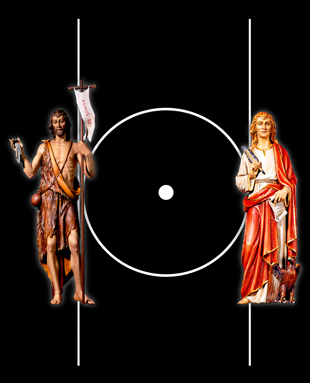
This is a symbol of great interest and importance, and brings us into close connection with the early symbolism of the solar orb and the universe, which was predominant in the ancient sun-worship. The lectures of Freemasonry give what modern Monitors have made an exoteric explanation of the symbol, in telling us that the point represents an individual Brother, the circle the boundary line of his duty to God and man, and the two perpendicular parallel lines the patron saints of the Order-Saint John the Baptist and Saint John the Evangelist.

But that this was not always its symbolic signification, we may collect from the true history of its connection with the phallus of the Ancient Mysteries.

The phallus was among the Egyptians the symbol of fecundity, expressed by the male generative principle. It was communicated from the Rites of Osiris to the religious festivals of Greece. Among the Asiatics the same emblem, under the name of Miriam, was, in connection with the female principle, worshiped as the symbols of the Great Father and Mother, or producing causes of the human race, after their destruction by the deluge.

On this subject, Captain Wilford (Asiatic Researches) remarks "that it was believed in India, that, at the general deluge, everything was involved in the common destruction except the male and female principles, or organs of generation, which were destined to produce a new race, and to re-people the earth when the waters had subsided from its surface. The female principle, symbolized by the moon, assumed the form of a lunette or crescent; while the male principle, symbolized by the sun, assuming the form of the lingam, placed himself erect in the center of the lunette, like the mast of a ship.

The two principles, in this united form, floated on the surface of the waters during the period of their prevalence on the earth; and thus became the progenitors of a new race of men." Here, then, was the first outline of the point within a circle, representing the principle of fecundity, and doubtless the symbol, connected with a different history, that, namely, of Osiris, was transmitted by the Indian philosophers to Egypt, and to the other nations, who derived, as is elsewhere shown, all their rites from the East.

It was in deference to this symbolism that, as Godfrey Higgins remarks (Anecalypsis ii, page 306), circular temples were in the very earliest ages universally erected in cyclar numbers to do honor to the Deity.

In India, stone circles, or rather their ruins, are everywhere found; among the oldest of which, according to Moore (Pancheon, page 242) is that of Dipaldiana, and whose execution will compete with that of the Greeks. In the oldest monuments of the Druids we find, as at Stonehenge and Avebury, the circle of stones. In fact, all the temples of the Druids were circular, with a single stone erected in the center. A Druidical monument in Pembrokeshire, called Y Cromlech, is described as consisting of several rude stones pitched on end in a circular order, and in the midst of the circle a vast stone placed on several pillars. Near Keswick, in Cumberland, says Doctor Oliver (Signs and Symbols, page 174) is another specimen of this Druidical symbol. On a hill stands a circle of forty stones placed perpendicularly, Of about five feet and a half in height, and one stone in the center of greater altitude. Among the Scandinavians, the hall of Odin contained twelve seats, disposed in the form of a circlers for the principal gods, with an elevated seat in the center for Odin. Scandinavian monuments of this form are still to be found in Scania, Zealand, and Jutland. But it is useless to multiply examples of the prevalence of this symbol among the ancients. Now let us apply this knowledge to the Masonic symbol.

We have seen that the phallus and the point within a circle come from the same source, and must have been identical in signification. But the phallus was the symbol of fecundity, or the male generative principle, which by the ancients was supposed to be the sun, they looking to the creature and not to the Creator, because by the sun's heat and light the earth is made prolific, and its productions are brought to maturity. The point within the circle was then originally the symbol of the sun; and as the lingam of India stood in the center of the lunette, so it stands within the center of the Universe, typified by the circle, impregnating and vivifying it with its heat. And thus the astronomers have been led to adopt the same figure as their symbol of the sun.

Now it is admitted that the Lodge represents the world or the universe, and the Master and Wardens within it represent the sun in three positions. Thus we arrive at the true interpretation of the Masonic symbolism of the point within the circle. It is the same thing, but under a different form, as the Master and Wardens of a Lodge. The Master and Wardens are symbols of the sun, the Lodge of the universe, or world, just as the point is the symbol of the same sun, and the surrounding circle of the universe.

To the above observations by Doctor Mackey, Brother Charles T. McClenachan adds these two paragraphs:

"An addition to the above may be given, by referring to one of the oldest symbols among the Egyptians, and found upon their monuments, which was a circle centered by an A U M, supported by two erect parallel serpents; the circle being expressive of the collective people of the world, protected by the parallel attributes, the Power and Wisdom of the Creator. The Alpha and Omega, or the will representing the Egyptian omnipotent God, surrounded by His creation, having for a boundary no other limit than what may come within his boundless scope, his Wisdom and Power. At times this circle is represented by the Ananta (a Sanskrit word meaning eternity), a serpent with its tail in its mouth. The parallel serpents were of the cobra species.

It has been suggestively said that the Masonic symbol refers to the circuits or circumambulation of the initiate about the sacred Altar, which supports the three Great Lights as a central point, while the Brethren stand in two parallel lines."

- Source: Mackey's Encyclopedia of Freemasonry

MEMENTO MORI - THE SYMBOL OF THE SKULL WITH CROSSED BONES

The symbol of the Skull and Crossbones, often called the Memento Mori, is a grim reminder of our own mortality. The Latin phrase Memento Mori is generally interpreted as “Remember that you must die”[i], and is often associated with other fatalistic expressions[ii] such as Hora Fugit (The Hour Flees) or Tempus Fugit (Time Flies). The first Masonic adoption of the Memento Mori appears to have its roots in the York Rite Chivalric Orders, especially the Order of Malta and the Order of the Temple. The establishment of these Orders coincides well with the periods in which the Memento Mori was reaching its zenith as an expression of Christian belief concerning death and dying. This paper will examine the evolution of the Memento Mori, its historic representations of death in the Christian belief system, and its adoption and use by Freemasonry. The reader is asked to be keenly aware that I am writing this strictly within the context of the Christian tradition; I am of course aware that many Masons are not themselves Christians, and I do this not out of religious conceit, but rather out of a need to narrow the scope of my investigation to that which is manageable in a paper of this type. I respectfully ask that my perspective not be construed as bigoted or intolerant.

see: http://www.freemasons-freemasonry.com/skull-bones.html

dimanche 3 mai 2009

Antiguos Documentos Masonicos

QQ:.HH:. y Estimados Lectores:


Aquellos que nos hemos interesado en el origen e historia de la Mas:. sabemos muy bien que su origen y fundación es tan compleja como apasionante.

En esta ocasión pongo a su disposición una lista en formato PDF de los "Early Masonic Documents". Estoy seguro que sera de gran interés para completar colecciones o archivos Mas:. .

Ademas de esta lista, tienen también a su disposición un PDF en Ingles de las Constituciones de Anderson. Aprovecho esta oportunidad QQ:.HH:. y estimados lectores para recordar que la Masonería cuenta con leyes y lineamientos claramente establecidos. Lamentablemente a lo largo de la historia miembros de nuestra augusta institución siempre han cuestionado el valor de dichos lineamientos. En la extensa lista de documentos que dictan y guían la reglas universales de la Masonería encontramos los Landmarks. Estoy seguro que todo hermano que desee comprender y practicar Masonería de manera universal y por el bien de la Humanidad entenderá que estos "antiguos limites" permiten una convivencia libre y fraterna entre los diferentes OOr:. y OOb:. que deseen trabajar de modo Regular. Ciertamente algunos miembros de la Orden consideran que la evolución de la Orden pasa por la modificación de lineamientos o reglas, pero aquí debemos preguntarnos a quien beneficia esto realmente. Lamentablemente la ignorancia esta presente aun dentro de nuestras filas, dado que la mayoría de los "HH:." que están en contra de los Landmarks ni siquiera se han tomado la molestia de leerlos antes de opinar.

La Masonería es vista y vivida de diferente modo por cada H:. pero al ingresar a ella se hacen juramentos, los cuales tienden a olvidarse con los años. La Mas:. esta diseñada para el beneficio de cada H:. y su desarrollo personal pero JAMAS a costa de otro H:. . Debemos interrogarnos entonces si el "miembro" de tal o tal Log:. al solo utilizar la Orden para su propia conveniencia no debería ser llamado al orden por su Taller, o incluso suspendido hasta que cambie de actitud. Esto es bastante difícil en la practica cuando sabemos bien que los intereses mezquinos infectan también las altas esferas de nuestras OOb:. . Seguramente algunos HH:. deben estar ofuscados por tales propósitos pero el cerrar los ojos no es una solución y esta situación es un claro reflejo del laxismo y desinterés de los Log:. en el momento de las elecciones.

Esta situación es simplemente consecuencia del distanciamiento entre LLog:. y Principios Básicos de la Orden. Es tiempo de retomar lo que le dio sus letras de Oro a la Orden, pulir nuestra piedra y alejarse de los ambiciosos e hipócritas.

~~~~~~~~~~~~~~~~~~~~~~~~~~~~~~~~


Early Masonic Documents
PDF

Las Constituciones de Anderson (English)
PDF

THE FOUNDATIONS OF REGULAR CRAFT RITUAL

In 1740 throughout Europe was circulating a Masonic oath written on a pamphlet invoking that the Freemason will protect and preserve the Traditions, Uses and Costumes of the Craft.

In order to preserve and avoid losing the original meaning and to prevent any further deviation and other foreign innovations from taking place, forced upon us by those not knowing the Traditions of the Craft, its uses and customs of Ancient Freemasonry, the Masonic High Council the Mother High Council issues the following Craft Document under the name and title of “The Foundations of Regular Craft Ritual”, to be used as the guidelines of Ancient and Regular Craft Masonry constituting the basic requirements for the perpetuation of Regular Craft Freemasonry.

1. All Craft Freemasonry Rituals had their origin in England.

2. That there be no debarment from membership because of nationality, of race, of colour, of sectarian or political belief; that a belief in the G.A.O.T.U. and His revealed will shall be an essential qualification for membership.

3. That all initiates shall take their Obligation on or in full view of the open Volume of Sacred Law, by which is meant the revelation from above which is binding on the conscience of the particular individual who is being initiated. At all times the book of Kings must be present as this is where the record of the building of Solomon’s Temple is first given and constitutes the base of the Craft legend.

4. That the Grand Lodge shall have sovereign jurisdiction over the Lodges under its control, i.e., that it shall be a responsible, independent, self-governing organisation with sole and undisputed authority over the Craft or Symbolic Degrees (Entered Apprentice, Fellow Craft, and Master Mason) within its jurisdiction; and shall not in any way be subject to, or divide such authority with, a Supreme Council or other Power claiming any control or supervision over those degrees.

4.1 That preserves, works and performs the complement ceremonies of the Mark Man, Mark Mason to the Fellow Craft Degree and Installed or Past Master Ceremonies to the Master Mason Degree, of which all this workings or ceremonies of Ancient Craft freemasonry must be used in complement to all Regular Craft Rituals of EA, FC and MM.

4.2 That no Master Mason shall be allowed to take the Chair of the WM of a Regular Craft Lodge if he has not been installed.

5. In accordance with earlier Craft English ritual the three Lesser or Movable Lights of the Lodge being the Sun, First Quarter Moon and the Worshipful Master shall always be on display when the Grand Lodge or its constituent Lodges are at work; to light man to, at, and from their work, the chief of these being the Worshipful Master.

6. That the three Great Lights of Freemasonry shall always be on display when the Grand Lodge or its constituent Lodges are at work: the Square, Compasses and the chief of these being the Volume of Sacred Law, these being the fixed lights of the Lodge.

7. As per the usage of the Grand Lodge of London (1717-1723) the two Wardens are situated in the West of the Lodge, and represent the two pillars at the entrance of King Solomon’s Temple, and the Brethren must always enter the Lodge between this two pillars, that the Masonic Delta with or without the all seeing eye must be placed above the altar or table of the Worshipful Master, (no other altar or extra altar exists in Craft Freemasonry).
Only wax candles are used on the altar or desk of the WM, SW, JW, Secretary, Orator, and around the Tracing Board of the Lodge.
The Sword a Masonic symbol its use must be preserved and maintained.
The Tracing Board must always be placed in its traditional place the centre of the Lodge.

8. That the principles of the Ancient Charges, Customs, and Usages of the Craft shall be accordingly observed.

8.1 That the Grand Officers and Officers of a Craft Lodge must be elected every year.

9. Master Masons Aprons can also be painted depicting the symbols of the Craft Freemasonry.

10. That a Grand Lodge must be multi-ritualistic.

10.1 That a Regular Craft Ritual has to have a Opening an Initiation and a Closing;
that it must make allusion to the G.A.O.T.U.;
that it must have at least the book of Kings must be present as this is where the record of the building of Solomon’s Temple is first given and constitutes the base of the Craft legend;
that the Legend is of the Craft Degrees is that of Hiram Abif or Adoniram and of no other.

11. That all Freemasons must believe in the Fatherhood of God, Brotherhood of Man and the immortality of the Spirit.

11.1 That the Ancient custom of Masonic Songs in Lodge should be encouraged and be maintained has it serves to further strength the Spirit of the Fraternity and deepen the Bonds of Brotherly Love among all Masons.

12. That the discussion of religion and politics within the Lodge shall be prohibited.

These Masonic principles constitute the Foundations of Regular Craft Ritual.

Lastly, this our Regulations shall be Recorded in our Registry, to show posterity how much we desire to revive the Ancient Craft upon true Masonical principles.


www.rgle.org.uk

The Order of the Royal Arch

The Order of the Royal Arch has long been considered a necessary part of Freemasonry, completing the Master Mason degree.1 And many claims have been made for the antiquity of the Royal Arch degree—based on a legend of rebuilding the Temple under Zerubbabel2—but unfortunately for promoters of the order, there is no evidence for either of these beliefs.

James Anderson, in his legendary History in 1723, wrote
"...wherein the Forms and Usages of the most ancient and worshipful Fraternity are wisely propagated, and the Royal Art duly cultivated, and the Cement of the Brotherhood preserved ; so that the whole Body resembles a well built Arch...."3
This has been cited as a reference to the Royal Arch degree by promoters of the order, but a dispassionate reading of the text does not support this interpretation. So, what are the earliest references?

The first known reference to the Royal Arch is found in Faulkner's Dublin Journal 10-14 January 1743 'which reported that Youghal Lodge No. 21 celebrated St. John's day with a parade in which "the Royall Arch was carried by two Excellent Masters".'4


In 1744, Fifield Dassigny published at Dublin a book entitled A Serious and Impartial Enquiry into the Cause of the Present Decay of Freemasonry in the Kingdom of Ireland in which he refers to the Royal Arch as a "false system" of "ridiculous innovations" brought to Ireland from York.5

Laurance Dermott, long time Secretary of the Ancient Grand Lodge of England, wrote that he had received the Royal Arch Degree in Ireland on 16 April 1746.

These three are the only known references to the degree prior to 1752, although, for about a decade prior to the latter date, the degree seems to have been conferred on Past Masters at York, London and Dublin.6

The first record of conferment of the Royal Arch degree was George Washington in the lodge at Fredericksburgh, Virginia, on 22 December 1753.7

Masonic scholars have long been in disagreement on the Royal Arch degree's relationship to the Master Mason degree. Although Herbert F. Inman wrote "that it is the proper completion of the Craft Third Degree none can deny,"8 Coil tells us : 'There is no evidence that any part of the Royal Arch Degree was ever part of the Third or other Craft degree, or that anything was ever lopped off from the Third Degree by Thomas Dunckerley or anyone else.'9 In the main, this historical legend can be ascribed to Dr. George Oliver. Again, while Alexander Lawrie, in his History of Freemasonry (1859) held that the Craft degrees were complete in themselves, Dr. W. J. Chetwode Crawley was firmly convinced that the Royal Arch degree was the completing part of the masonic legend.

The Premier Grand Lodge of England signed a Charter of Compact on 22 July 1766 which constituted the Grand and Royal Chapter of the Royal Arch of Jerusalem. In this document, and the records leading up to it, Harry Carr, and many masonic writers of the latter twentieth century agreed with Harry Mendoza who wrote : "there is not the slightest evidence that the Royal Arch is the completion of the M.M.'s degree."10

In the face of this, we're told, in the earliest editions of the Laws for the Society of Royal Arch Masons issued by the Supreme Grand Chapter from 1778 to 1807, that "...by the instructions received in passing through the several probationary degrees of the Craft, (we) are prepared for our most sublime one — namely, Speculative Masory, or the Royal Arch...."11

Note should be made of the language used in the Act of Union when it was "declared and pronounced that pure Antient Masonry consists of three degrees and no more, vizt., those of the Entered Apprentice, the Fellow Craft, and the Master Mason, including the Supreme Order of the Holy Royal Arch."12

While Laurence Dermott had described the degree as "the Root, Heart and Marrow of Freemasonry"13 and the Antient's Royal Arch regulations of 1794 stressed the importance of "the fourth degree, the Holy Royal Arch"14, the Act of Union refers to the Order but does not qualify it as a degree. The minutes of a Special Convocation of the Supreme Grand and Royal Chapter on 30 November 1813 record their understanding that "by Those Articles the Royal Arch was acknowledged as the perfection of the Master's Degree...."15

Masonic authors such as J. E. S. Tuckett and Count Goblet d'Alviella have argued for the antiquity of the Royal Arch degree and its use as a completion of the Hiramic Legend, while A. F. A. Woodford, Albert Mackey and George Oliver maintained that the Third degree was "mutilated" to create the Royal Arch degree. Bernard E. Jones points out that this opinion is not supported by fact: "There does not seem to be any evidence to support the statement that the Royal Arch was originally a part of any Craft degree."16

J. Heron Lepper, says that he is unable to "accept the theory that the Royal Arch formed an integral part of the ancient masonic tradition." This view is supported by W. Redfern Kelly, William James Hughan and others.17 Gould describes it as a "side or bye degree", a "new degree of Continental origin".18

"Douglas Knoop, a professional historian of marked ability, stated definitely that there is no evidence that our Third Degree legend and our R.A. legend were ever combined in one ceremony."19 This would appear to be the consensus of scholarly opinion today.

This is not to denigrate the value or appropriateness of the Royal Arch degree within Freemasonry. The real history of its growth and development is worthy of study, as are the lessons contained in its teachings.

Source: freemasonry.bcy.ca